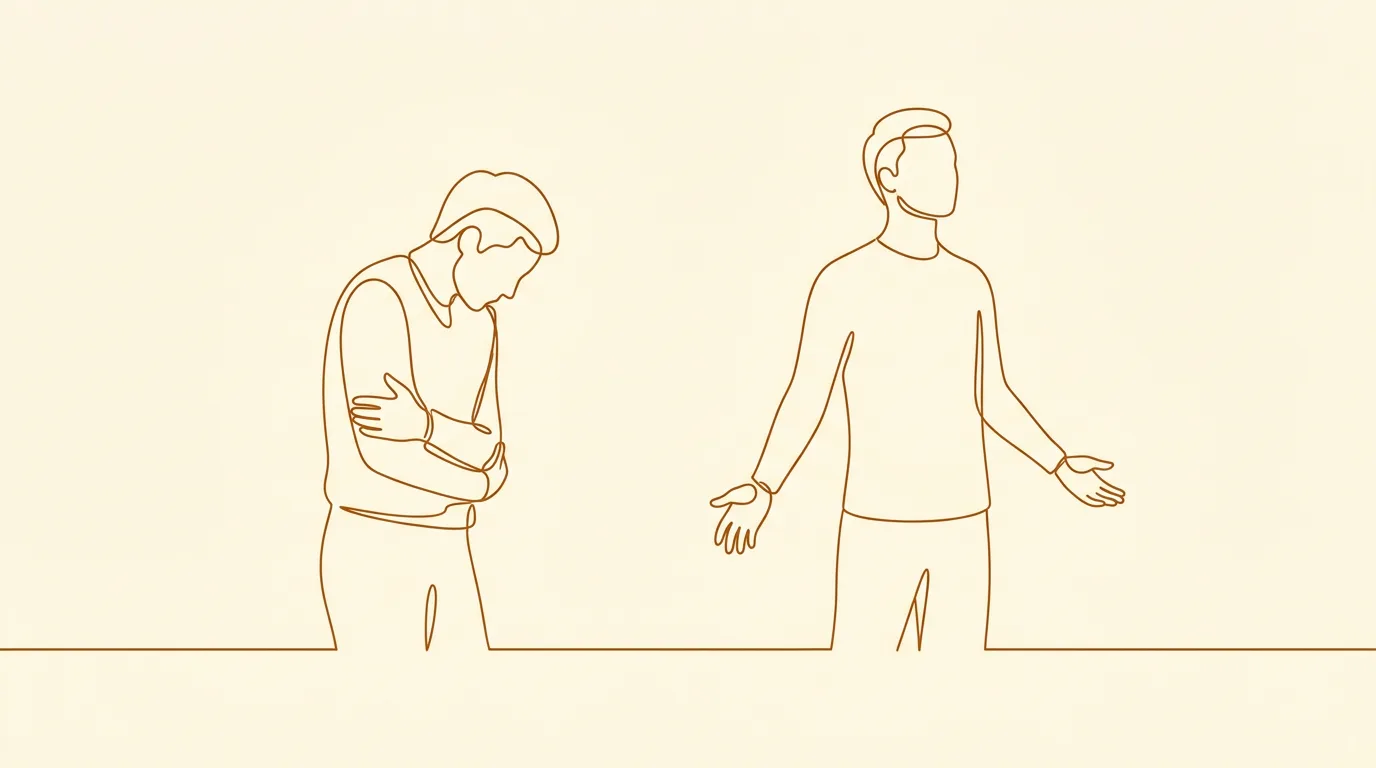
After a porn relapse, shame can arrive quickly and feel heavier than ordinary disappointment.
That shame may look like accountability at first. In practice, it often makes the next hour harder. When the main feeling is self-attack, the person may look for fast relief instead of looking clearly at what happened.
This is the shame spiral: porn use, shame, emotional pain, the urge to escape that pain, and more porn use. Quitting porn without shame works best when the response stays practical: name what happened, reduce secrecy, and choose the next repair step.
Key takeaways
- Shame can increase relapse risk when the emotional pain becomes a trigger for more use
- Guilt can be useful briefly when it points to a behavior to repair; shame turns the behavior into identity
- After a relapse, replace self-attack with a factual review: what happened, what was active, and what needs to change?
- Treat relapses as information about the plan and where it needs more support
- Self-compassion can support accountability when it keeps you engaged with repair instead of avoidance
The difference between shame and guilt
These two words often get used interchangeably, but the difference matters for recovery.
Guilt says: "I did something that does not align with who I want to be."
Shame says: "This behavior proves something bad about who I am."
After a relapse, the useful review stays with the specific action, the conditions around it, and the repair that comes next.
Guilt can be productive for a short time. It creates a gap between your actions and your values, and that gap can motivate repair. After a relapse, guilt can say: "That is not the behavior I want, so I need to understand what happened and adjust the plan."
Shame is usually less useful. It collapses the person into the behavior. Instead of "I did something I do not want to repeat," the thought becomes "this is who I am." That makes it harder to believe that the next choice can be different.
Research backs this up. A study published in Addictive Behaviors found that shame-proneness was positively correlated with substance use problems, while guilt-proneness was inversely related to them, confirming that shame and guilt have opposite effects on recovery.
This is why shame tends to make recovery harder. It reduces the belief that change is possible, which can reduce the motivation to return to the plan.
How the shame spiral works
The shame spiral follows a predictable pattern:
- Trigger → an urge fires (stress, boredom, loneliness, anything)
- Relapse → you act on the urge
- Shame → self-disgust, hopelessness, or harsh self-talk
- Emotional pain → the shame itself creates intense emotional distress
- Urge → your brain seeks relief from the distress
- Relapse → the cycle repeats, often within hours or days
In this loop, the shame from one relapse becomes the emotional trigger for the next. The spiral feeds itself when the person has no clear post-relapse response.
This is one reason people often experience relapses in clusters. The first slip creates emotional pain, and the person may try to escape that pain with the same behavior.
Breaking the shame spiral means interrupting the loop at step 3: responding to a relapse without letting shame become the next trigger. This is different from excusing the behavior.
Why shame sticks so hard
If shame is so counterproductive, why do people keep falling into it? A few reasons:
Shame feels like accountability
Many people believe that the worse they feel after a relapse, the less likely they are to do it again. "If I let myself off the hook, I'll never stop." So they punish themselves emotionally, hoping the pain will work as a deterrent.
Research does not support that approach. Shame-proneness is associated with increased substance use problems (Dearing, Stuewig & Tangney, 2005), and elevated shame predicts slower recovery (Batchelder et al., 2022). The emotional pain shame creates can demand relief, and the most available relief may be the behavior you are trying to stop.
Cultural and religious messaging
Many people carry shame about sexuality that was learned long before porn became an issue. Messages about purity, sin, and sexual wrongness can create a framework where sexual behavior, especially compulsive behavior, feels like evidence of personal failure.
If this is part of your story, the useful task is to separate your values from self-attack. You can maintain your values about porn while letting go of the belief that relapsing makes you worthless.
Isolation amplifies shame
Shame thrives in secrecy. The more isolated you are with the behavior, the bigger the shame grows. When you believe nobody else struggles with this, every relapse confirms your worst suspicions about yourself.
Many people are dealing with the same pattern. The behavior still matters, and the problem can be addressed with support, structure, honesty, and repair.
Building a shame-free recovery approach
A shame-free approach still has consequences, and it still takes relapse seriously. The difference is the response after a setback: it should produce information, support, and one next repair.
Replace self-attack with diagnosis
After a relapse, the shame response is: "I'm a failure." The factual response is: "What happened?"
Train yourself to ask these questions within an hour of a relapse:
- What was the trigger? Was it boredom, stress, loneliness, a late night?
- When did the urge first appear? Was there a moment where you could have intervened?
- What was going on in your body? Were you tired, hungry, tense, wired?
- What story did your brain tell you to justify the behavior?
The purpose is to find information that helps you repair the plan. Every relapse contains data about trigger patterns, vulnerable moments, and gaps in the current plan. That data is useful only if you can access it without being buried in shame.
Treat relapse as information about the plan
When a recovery plan breaks down, ask which part was not strong enough for the situation. Maybe the plan did not account for nighttime triggers. Maybe it relied on willpower that was not available after a 12-hour workday. Maybe there was no physical interrupt built into the response.
These are practical problems. They can be adjusted.
Practice self-compassion (without making excuses)
Self-compassion can be misunderstood as self-indulgence. Research by Breines and Chen (2012) found that self-compassion (treating yourself with the same kindness you would offer a friend) can increase motivation to change and accountability compared with self-criticism.
After a relapse, try this:
- Acknowledge the pain. "This hurts. I didn't want this to happen, and I'm disappointed."
- Normalize the struggle. "Millions of people deal with this. It's hard. I'm not the only one."
- Recommit without ultimatums. "I'm going to adjust my plan and return to the routine." Avoid absolute promises that create more shame if another slip happens.
Talk to someone
One way to reduce shame is to say what happened to another person. That might be a therapist, a trusted friend, a support group, an anonymous forum, or anyone who can hear your experience without adding judgment.
When you say "I relapsed" to someone who responds with understanding instead of disgust, the behavior becomes easier to discuss honestly. That matters because secrecy often keeps the shame cycle active.
If you do not have anyone to talk to yet, finding that person or community is an important recovery step.
Build identity around the process, not the streak
Counting days of sobriety can be motivating, but it also sets a trap: when you relapse, the counter resets to zero, and it feels like everything you built was destroyed.
It was not destroyed. Thirty days of recovery followed by a relapse is different from no recovery at all. The skills you built, the triggers you identified, and the urges you rode out still matter after one slip.
Try building identity around the process: "I'm someone who is learning to handle urges." "I'm someone who is building a different relationship with emotions." These identities are more stable than a single number.
What to do right after a relapse
Use a concrete protocol for the first hour after a relapse:
- Breathe. Take five slow breaths. This interrupts the emotional flooding.
- Name what happened, without judgment. "I relapsed. The trigger was [X]. I was feeling [Y]."
- Write a quick note. What triggered it, what you were feeling, what your plan was missing. This turns the experience into something you can learn from instead of another source of shame.
- Do one caring thing for yourself. Drink water. Take a shower. Step outside. Eat something. This helps move the moment out of crisis mode.
- Adjust one thing in your plan. Based on what you just learned, change one element: an earlier phone curfew, a new evening routine, or a physical reset you will try next time. This gives the relapse a practical consequence.
The goal is to make the period after a relapse useful instead of punitive.
Build repair into the recovery plan
Porn can become a way to manage discomfort, stress, loneliness, boredom, or emotional pain. When shame is added after the behavior, recovery becomes harder because the person now has another painful feeling to escape.
Recovery works better when repair is built into the plan before a setback happens. Prepare the first-hour response in advance so a slip leads back to structure quickly.
For the full framework on understanding and responding to urges, read Urges and triggers: the complete guide. When the next urge comes, try urge surfing instead of relying on force alone.