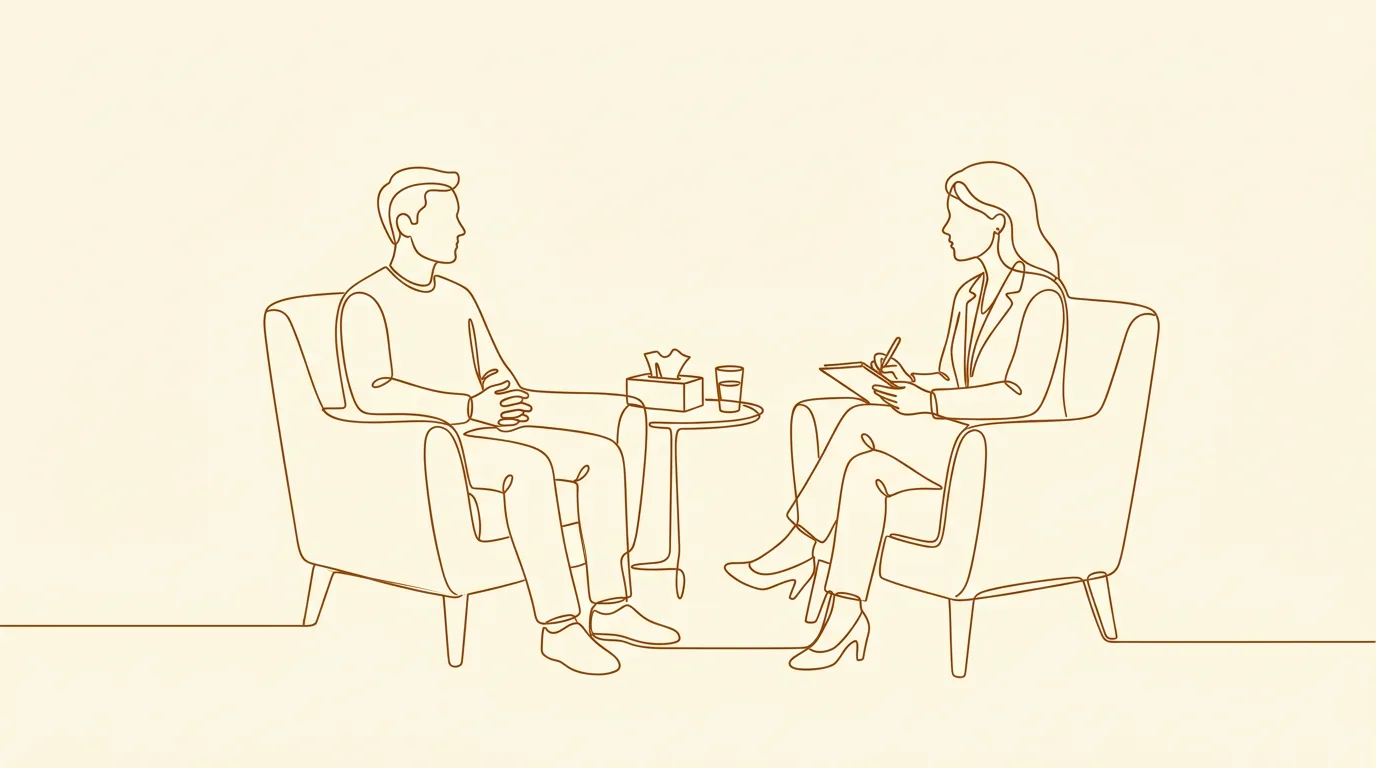
Talking to a therapist about porn can feel exposing. You may have rehearsed the conversation and still feel unsure how to say it out loud.
Therapists who work with compulsive sexual behavior are used to direct conversations about porn, masturbation, shame, secrecy, relationships, and relapse. The first session does not need to sound polished. It needs to give the therapist enough information to understand what is happening.
The practical work is finding someone who can handle the topic well, then giving them a clear starting point.
Key takeaways
- Look for a therapist with specific experience in compulsive sexual behavior; a good general therapist may still fumble when porn comes up
- Use the free 15-minute consultation to screen for experience, approach, and whether they take the issue seriously without shaming you
- You do not need a perfect opening line; "I'm struggling with compulsive porn use and it's affecting my life" is enough to start
- CBT, ACT, and psychodynamic therapy each help in different ways; the best choice depends on whether your use is habit-driven, urge-driven, or trauma-rooted
- Cost, embarrassment, and "it's not bad enough" are common barriers; screening calls and lower-cost options can make the first step smaller
How to find the right therapist for porn addiction
Not every therapist is a good fit for this work. A skilled couples therapist or anxiety specialist may still have limited experience with compulsive porn use. Look for someone who:
- Has specific experience with compulsive sexual behavior, problematic porn use, or sex addiction (depending on the framework they use)
- Does not shame you, including subtle judgment or moralizing
- Uses evidence-based approaches rather than ideology
- Treats the behavior as a real clinical issue, not something you should simply "stop doing"
Where to look
- Psychology Today's therapist directory, filter by "sex addiction" or "compulsive behaviors" in the specialty dropdown
- AASECT (American Association of Sexuality Educators, Counselors and Therapists), for therapists trained in sexual health specifically
- IITAP (International Institute for Trauma and Addiction Professionals), for therapists trained in the addiction model of compulsive sexual behavior
- Your primary care doctor, ask for a referral to someone who handles behavioral addictions
Online therapy is a valid option if your area doesn't have specialists. Many therapists who work with porn and compulsive sexual behavior offer video sessions.
How to screen a therapist before committing
Most therapists offer a free 15-minute consultation call. Use it. Ask:
- "Do you have experience working with people who have compulsive porn use?"
- "What's your general approach to treating it?"
- "How do you view porn use: as an addiction, a compulsive behavior, or something else?"
You're not looking for a specific "right" answer to that last question. You're looking for someone who takes it seriously and can explain their framework clearly. If they seem dismissive, vague, or uncomfortable, move on.
What to say in the first session
You do not need a speech. You do not need to have your whole history organized. Therapists are trained to guide the conversation. If having a starting point makes you less anxious, use one of these:
- "I've been struggling with compulsive porn use and it's affecting my life. I want to address it directly."
- "I think I have a problem with porn. I'm not sure how bad it is, but I know I need help figuring that out."
- "I've tried to quit on my own multiple times and I keep going back. I'm ready to try a different approach."
Any of those works. You do not need clinical language, and you do not need to label yourself an addict. Be clear about why you are there.
What they'll probably ask
In the first session or two, expect questions like:
- When did you start using porn?
- How often do you use it now?
- Have you tried to stop before? What happened?
- How is it affecting your relationships, work, or mood?
- Do you use other substances or have other compulsive behaviors?
- What's your goal: complete abstinence, reduced use, or something else?
These are not trick questions. The therapist is building a picture of your situation so they can tailor treatment. Answer as honestly as you can; the details help them help you.
What if you can't say it out loud?
If the words do not come, write them down before the session and hand over the note or read it aloud. Many people do this for the first session. The information matters more than the delivery.
Types of therapy that actually help
Cognitive behavioral therapy (CBT)
CBT is the most widely studied approach for compulsive behaviors, including problematic porn use. It helps you:
- Identify the thoughts and beliefs that trigger use ("I deserve this," "Just one more time won't hurt")
- Recognize high-risk situations before you're in them
- Build concrete coping strategies for urges
- Challenge distorted thinking patterns around sex, shame, and self-worth
CBT is practical and structured. You'll get homework. You'll track patterns. A 2022 systematic review in the Journal of Behavioral Addictions found evidence that CBT improves symptoms of both compulsive sexual behavior disorder and problematic pornography use, with treatment effects remaining stable at 3- and 6-month follow-ups. If you want something action-oriented, this is a strong choice.
Acceptance and commitment therapy (ACT)
ACT takes a different angle. Instead of fighting urges directly, it teaches you to:
- Accept uncomfortable feelings without acting on them
- Defuse from unhelpful thoughts (recognizing them as mental events, not commands)
- Clarify your values and commit to actions aligned with them
ACT can be useful if fighting urges head-on tends to make them stronger. It helps you notice the urge and choose an action that fits your values.
Psychodynamic or depth-oriented therapy
This approach looks at the emotional and relational context behind the behavior. It explores:
- Childhood experiences and attachment patterns
- Emotional wounds that porn is medicating
- Relational dynamics that drive compulsive behavior
This is slower and less structured than CBT or ACT, but it can be valuable when porn use is tied to trauma, early sexual experiences, attachment, or long-running emotional patterns.
EMDR (eye movement desensitization and reprocessing)
If trauma is a significant driver of your porn use, EMDR can help process traumatic memories that fuel compulsive behavior. It's often used alongside other approaches rather than as a standalone treatment for porn addiction.
What to expect from treatment
It won't be one session
Recovery work often involves weekly sessions over several months. Some people benefit from ongoing therapy for longer. A repeated pattern usually needs time, practice, and support.
You may feel worse before you feel better
As you start examining your patterns honestly, emotions that porn helped you avoid may surface. That can be uncomfortable. A good therapist will help you process this at a pace you can tolerate.
Relapse is part of the conversation
A good therapist will use a relapse to understand the pattern. What triggered it? What was happening emotionally? What can you learn from it? If your therapist makes you feel ashamed after a relapse, find a different therapist.
Therapy works alongside everything else
Therapy isn't the only tool. It works best when combined with your own daily practices: urge management, journaling, exercise, reducing triggers. If you are comparing therapy with support groups, online tools, and medication questions, start with porn addiction treatment. The therapist gives you insight and strategy. You do the daily work.
Common fears that keep people from starting
"They'll judge me." Therapists trained in this area should be able to discuss compulsive sexual behavior without shock or moralizing. If someone responds with shame or dismissal, that is useful information about fit.
"It's not bad enough to need therapy." If it is affecting your mood, relationships, self-image, or ability to stop, that is enough reason to ask for support. A quick pass through this self-assessment can help you see the pattern more clearly.
"I should be able to handle this alone." Some people can. Many people need support. The research on why willpower alone doesn't work explains why solo attempts often stall. An accountability partner can also help alongside therapy.
"I can't afford it." This is a real barrier. Look into therapists who offer sliding-scale fees, community mental health centers, university training clinics (where graduate students provide supervised therapy at reduced cost), or online platforms that offer lower rates.
Starting with one conversation
A 15-minute consultation can be a low-pressure way to start. It does not commit you to long-term therapy. It gives you a chance to ask direct questions and notice whether the therapist responds with clarity and respect.
If you are not ready for therapy yet, start with understanding what the recovery process looks like or whether quitting is worth it. Keep therapy on the map if the pattern keeps repeating, if shame is increasing, or if you need more structure than self-help can provide.