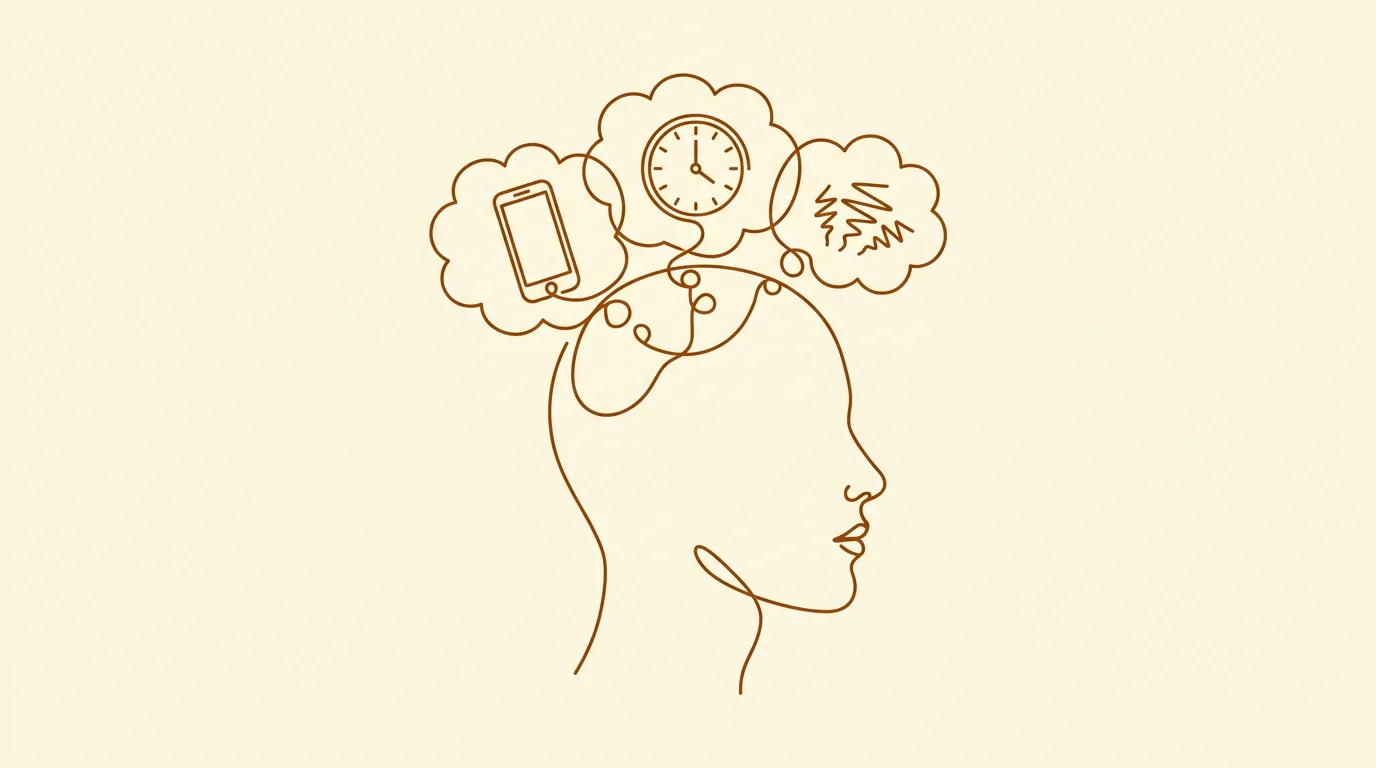
You may be a few weeks into recovery when a sexual thought appears during an ordinary moment: in public, while working, while cooking, or while lying in bed. It may be triggered by someone you see, by a memory, or by no obvious cue.
That moment can create immediate alarm. You may wonder whether the thought counts as a relapse, whether it will turn into a spiral, or whether it means recovery is not working.
Early recovery can make sexual thoughts feel more dangerous than they are. Sexual thoughts are a normal part of being human. What matters in porn recovery is that those thoughts may have been linked to a compulsive behavior: opening a browser, picking up a phone, and going on autopilot into porn.
Recovery weakens the automatic link between having a thought and acting on it. Sexual thoughts still come; the important part is what happens next. That response is a skill, and like any skill, it gets easier with practice.
Key takeaways
- Sexual thoughts during recovery are normal; recovery changes your response to them
- A passing sexual thought and a compulsive urge feel different: one can pass, while the other narrows attention and pulls toward action
- Trying to suppress sexual thoughts can make them more frequent and more intense through the psychological rebound effect
- The first 5 to 10 seconds after the thought are a useful place to intervene before fantasy, urgency, or autopilot builds
- Over time, the compulsive charge behind sexual thoughts can fade as you practice a different response
Normal sexual thoughts vs. compulsive urges
It helps to separate two experiences that can both be called "sexual thoughts."
Normal sexual thoughts
These are the ordinary sexual thoughts that human brains generate. They may include noticing that someone is attractive, having a brief sexual daydream, remembering a pleasant intimate experience, or responding to something suggestive in a movie or a song.
Normal sexual thoughts have a few qualities:
- They arise and pass without a sense of urgency
- You can notice them without feeling compelled to do anything
- They don't narrow your attention or hijack your focus
- They may feel neutral unless you've been taught that all sexual thoughts are bad
- They're part of your general mental landscape
These thoughts can usually be noticed and allowed to pass without a recovery intervention.
Compulsive urges disguised as thoughts
These feel different. If you have been through a porn addiction cycle, the difference may show up as urgency, narrowing attention, or a familiar move toward access.
A compulsive urge disguised as a sexual thought has these qualities:
- It escalates: a mild thought quickly becomes vivid, specific, and fantasy-driven
- It narrows your focus: the world shrinks to the thought and the possibility of acting on it
- It generates urgency: you feel like you need to do something about it right now
- It has a familiar pull toward a specific behavior (reaching for your phone, opening a laptop, going somewhere private)
- It often carries a "negotiation" tone: "just a quick look," "you deserve this," "it's not a big deal"
The content of the thought matters less than its quality. A sexual thought about your partner can be healthy. A sexual thought about a stranger can be healthy. The compulsive part is the driven, escalating, action-demanding quality.
Learning to tell these apart makes it easier to choose the right response.
Why suppression can make thoughts louder
When a sexual thought appears, many people in recovery instinctively try to force it away, distract themselves immediately, or scold themselves for having it.
That reaction is understandable, but it tends to make the thought more persistent.
Psychologists call this thought suppression, and it's been studied extensively. The consistent finding is that trying not to think about something makes you think about it more. This is called the rebound effect, sometimes known as the "white bear" phenomenon. In the original 1987 study, participants told not to think of a white bear were unable to suppress the thought, and afterward showed even greater preoccupation with it than a control group, demonstrating that "attempted thought suppression has paradoxical effects as a self-control strategy."
When you try to suppress a sexual thought:
- Your brain devotes monitoring resources to scanning for the thought, which paradoxically keeps it active
- The effort of suppression is stressful, and stress makes cravings worse
- When the thought inevitably returns (because you were monitoring for it), it feels stronger and more meaningful than it would have if you'd just let it pass
- You start associating sexual thoughts with anxiety and failure, which creates a feedback loop: thought, panic, suppression attempt, rebound, more panic
A better response is to acknowledge the thought and let it move through you without resistance or escalation.
The first few seconds
A sexual thought is easier to handle before it turns into active fantasy or a search for access. The first 5 to 10 seconds are often the most useful intervention point.
The typical escalation sequence looks like this:
- A sexual thought appears (this is the neutral event)
- You engage with it: you start elaborating the fantasy, adding details, replaying it
- Arousal builds and your attention narrows
- The negotiation voice starts: "just a peek," "you can stop whenever you want"
- You reach for the phone or laptop
- Autopilot takes over
The intervention point is between steps 1 and 2. Once you're actively elaborating the fantasy, momentum builds quickly. At step 1, the thought is still just a thought. If you do not feed it with detail, it is more likely to pass.
The acknowledge-and-redirect technique
When a sexual thought appears:
Step 1: Name it without judgment (1 to 2 seconds)
Use a simple neutral label: "That's a sexual thought." Leave out moral evaluation or a second round of analysis.
Step 2: Check whether it is escalating (2 to 3 seconds)
Is this a passing thought, or is it growing stronger? Do you feel calm, or compelled to act? Is it taking over your attention? If it is passing, let it go.
If it feels urgent, intensifies, or pulls you toward a behavior, move to step 3.
Step 3: Redirect your attention to something specific (5 seconds)
Redirect to something concrete and engaging. A vague instruction like "think about something else" often gives your attention too little to work with:
- Start a conversation with someone nearby
- Open a specific task you need to do and engage with the first step
- Do a quick physical interrupt: stand up, splash cold water on your face, do 10 push-ups
- Call or text someone
- If you're in bed, get up and leave the room
The useful part is specificity. "Think about work" is vague; "open the email from your boss and draft a reply" gives your attention a clear next step.
Healthy sexuality during recovery
One fear that keeps people stuck is the idea that recovery means becoming asexual, or that you have to shut down your sexuality entirely to be safe.
Trying to shut down sexuality is usually counterproductive. The recovery target is the specific compulsive behavior that linked sexual arousal to a screen.
During recovery, your relationship with sexuality usually changes gradually. The process often looks like this:
Early recovery (weeks 1 to 4)
Sexual thoughts may be strongly linked to porn content. Fantasies might default to scenes or categories you watched. This is common early on, while the old cues are still familiar.
During this phase, the "acknowledge and redirect" approach matters most. When a porn-based fantasy appears, label it and return to the next concrete activity rather than elaborating it or trying to edit it into a healthier version. With repeated non-use, the old pattern can weaken.
If you're going through the flatline, you might have very few sexual thoughts at all during this period. That can also happen.
Mid recovery (months 2 to 4)
Sexual thoughts start shifting. You may notice more attraction to real people, more responsiveness to physical presence rather than visual stimulation. Fantasies become less scripted and more organic.
This transition can feel disorienting. Your old sexual template was shaped by years of porn, and the new one is still forming. Some awkwardness is normal during this shift.
Later recovery (months 5 and beyond)
Sexual thoughts feel more natural, more connected to genuine desire and less driven by compulsion. Healthy sexual thoughts often have more openness to them. Compulsive ones tend to feel narrow and urgent.
Specific scenarios and how to handle them
Sexual thoughts about porn content
"I keep replaying scenes from porn I watched."
Porn scenes can replay because your brain stored them with unusually strong reward cues. They'll resurface, especially in the first few months.
Avoid engaging with it, elaborating it, or treating it as an emergency. Label it ("that's a porn memory") and redirect. These memories can lose some of their charge over time when they are not repeatedly reinforced.
Sexual thoughts triggered by everyday situations
"I saw someone attractive at the gym and my brain went straight to fantasy."
Noticing attractiveness is normal. The automatic jump to fantasy is the conditioned response you're rewiring.
When this happens, bring your attention back to the situation you are actually in. Notice the person as a person, notice the automatic fantasy response, and then return to the activity in front of you. This repeats the same recovery skill in a practical setting: interrupting the move from cue to fantasy to action.
Sexual thoughts before sleep
This is one of the highest-risk scenarios because you're tired, your defenses are lower, and you're alone with your thoughts. Porn use often happened in this exact context, so the association is strong.
Build a pre-sleep routine that occupies your mind: reading a physical book (not your phone), listening to a podcast or audiobook, doing a 5-minute breathing exercise. Make the bedroom a place where the default activity is sleep, not browsing. For more help with urges at that time of night, see Late-night urges.
Sexual thoughts during intimacy with a partner
If you're in a relationship, you might notice intrusive porn-related thoughts during sex with your partner. This can feel deeply shameful.
This is common, and for many people it is temporary. Your brain built strong associations between sexual arousal and porn content. Those associations can fire during intimacy because the arousal state is similar.
The practice is the same: notice without panic, gently redirect your attention back to the physical sensations and the person you're with. Focus on touch, sound, eye contact, and the reality of what is happening in the room. Over time, these intrusions may become less frequent.
Building a healthy relationship with your own mind
The deeper skill underneath all of this is learning to observe your own thoughts without being controlled by them. This is sometimes called metacognition: thinking about thinking.
Thoughts arise automatically, shaped by conditioning, memory, brain chemistry, and randomness. A sexual thought can appear the same way a thought about lunch or a song lyric can appear, without a deliberate choice.
The recovery work is in the response. Each time you respond to a sexual thought with calm observation instead of panic or compulsion, you practice a different response: the thought can be noticed, and the day can continue.
This is different from suppression. The thought happens, you see it, and you let it go. You can notice it without treating it as bad or urgent.
When to get additional help
If intrusive sexual thoughts are persistent, distressing, and feel genuinely out of your control (not just uncomfortable, but impairing your ability to function), it may be worth talking to a therapist. Intrusive thoughts can be a feature of OCD or anxiety disorders, and these conditions respond well to specific therapeutic approaches.
If the intrusive thoughts focus on children or fears about pedophilia, POCD and porn explains why porn-based checking can make that specific OCD loop worse.
You can read How to talk to a therapist about porn for guidance on finding someone who understands compulsive sexual behavior without shaming you.
There's a difference between "I had a sexual thought and I'm learning to let it pass" and "I'm bombarded by unwanted sexual images all day and it's making me unable to work or sleep." The first is normal recovery. The second deserves professional support.
When the thought returns
Sexual thoughts will continue to appear during recovery. The useful question is what happens in the moments after the thought arrives.
Panic, suppression, and force can make the thought feel bigger and more threatening.
Noticing the thought, naming it, allowing it to be present for a moment, and then returning to what you were doing is a practical repetition of the recovery skill.
Over time, that repetition weakens the link between "sexual thought" and "open a browser." It also strengthens the link between "sexual thought" and "return to what I was doing." Eventually, the second response can become more automatic.
Recovery includes building a steadier response to sexual thoughts, one repetition at a time.
For a step-by-step technique on riding out urges when they do escalate, read the Urge surfing guide.