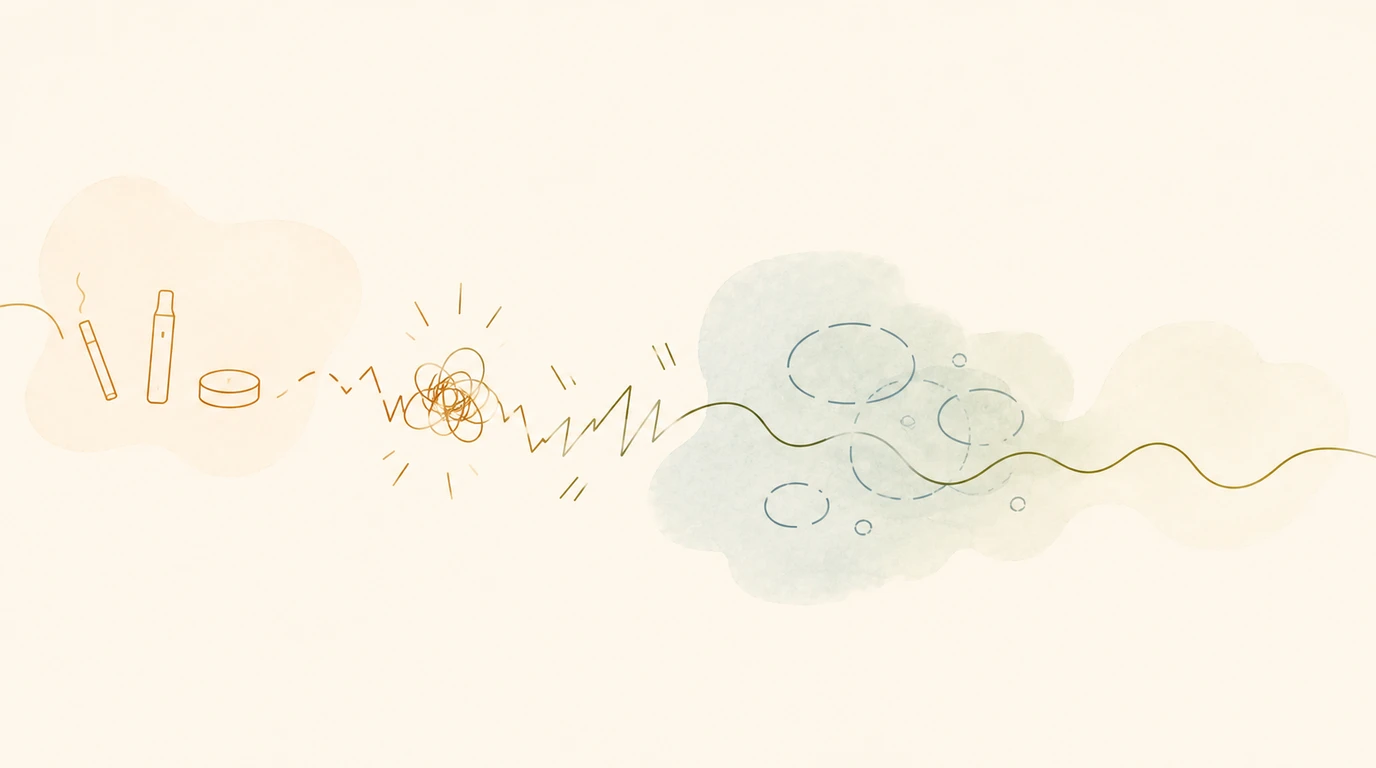
Nicotine withdrawal can make you feel irritable, tense, restless, and mentally foggy. You may lose patience faster, find ordinary uncertainty harder to tolerate, or need more effort to follow a conversation or complete a familiar task. These symptoms often overlap, which can make an ordinary day feel unusually demanding.
This cluster belongs to acute withdrawal. It usually becomes most noticeable during the first days after stopping or sharply reducing nicotine and then eases over the following weeks. The exact pattern varies, and a practical plan should leave room for symptoms that arrive at different times or reach different intensities.
Key takeaways
- Irritability, anxiety, restlessness, and difficulty concentrating are established nicotine withdrawal symptoms
- These symptoms commonly become strongest during the first week and often improve over two to four weeks
- Brain fog is an informal label for experiences such as slower thinking, reduced attention, and working-memory difficulty
- Lowering optional demands, externalizing tasks, and creating space before reacting can make the acute period safer and more manageable
- Smoking cessation can slow caffeine clearance, so the same coffee intake may add more tension or sleep disruption
- Severe, worsening, persistent, or unfamiliar symptoms deserve professional assessment
Why these nicotine withdrawal symptoms overlap
Irritability, anxiety, restlessness, and difficulty concentrating appear together in established nicotine withdrawal measures. A review of more than 3,500 citations identified anger, anxiety, difficulty concentrating, impatience, insomnia, and restlessness as valid tobacco-abstinence symptoms (Hughes, 2007). These symptoms can influence one another during a real day.
Restlessness may make it harder to sit through a task. Concentration difficulty can turn a small interruption into a larger frustration. Anxiety can keep attention fixed on uncertainty or body sensations. Poor sleep can add fatigue and reduce patience. A craving can appear within the same period and draw attention back toward nicotine.
The symptoms also have other possible causes. Work pressure, conflict, sleep loss, illness, caffeine, medication changes, and an existing anxiety or attention condition can create similar experiences. Timing provides useful context: a clear increase after stopping or reducing nicotine supports a withdrawal explanation, while symptoms that started earlier, continue to worsen, or feel unlike your usual pattern deserve a broader assessment.
The complete nicotine withdrawal symptoms guide covers the full symptom list, product applicability, overall timeline, and escalation guidance. This guide stays with the acute mood-and-concentration cluster.
When irritability, anxiety, and brain fog tend to peak
Withdrawal can begin within hours of the last nicotine use. A large review found that anger, anxiety, difficulty concentrating, and restlessness generally peak during the first week and last about two to four weeks (Hughes, 2007). An earlier clinic study followed 147 people who remained abstinent from smoking for four weeks. Irritability, difficulty concentrating, and restlessness peaked during the first week or two and returned to baseline by week four (West, Hajek, and Belcher, 1989).
These findings describe groups of people who stopped smoking. Group averages leave the timing uncertain for any one person, and research is less complete for exclusive vaping, nicotine pouches, and other newer products. Product strength, frequency, time to first use, sleep, stress, use of quit aids, and individual health can all change the experience.
Symptoms may also fluctuate within one day. A difficult morning offers limited information about the shape of the whole week. Track the strongest point, what else was happening, and whether the symptom changed after food, rest, movement, a quieter setting, or the end of a demanding task. The first seven days without nicotine provides a broader day-by-day orientation without turning one peak day into a rule.
Irritability and restlessness during withdrawal
Irritability can feel like reduced tolerance for noise, delays, mistakes, questions, or other people. Restlessness may feel physical, such as needing to move, or mental, such as repeatedly switching tasks and finding it hard to settle. Both can make a minor inconvenience feel more urgent.
High symptom intensity can affect a quit attempt. In a retrospective study of 741 people who had used a national quitline, stronger irritability, anxiety, concentration difficulty, restlessness, low mood, insomnia, and cravings were associated with unsuccessful attempts (Tomson et al., 2006). A difficult hour still has little predictive value. The association supports planning for the symptoms while they are active.
The guide to depression and low mood after quitting nicotine covers mood monitoring, daily function, professional support, and urgent safety signs in more depth.
Create space around predictable points of friction:
- Move optional disagreements, complex requests, and major decisions out of your hardest withdrawal window when possible
- Tell people close to you that your patience may be lower for a short period and that you may take a pause before responding
- Keep written notes for important conversations so the main point stays available during concentration difficulty
- Give restless energy a safe outlet through a walk, household task, stretching, or another form of movement that fits your health and setting
- Step away briefly when your response is becoming sharper than the situation requires, then return at a specific time
A pause protects the conversation while the underlying issue remains available for later discussion. The guide to withdrawal irritability and relationships covers advance communication, planned pauses, boundaries, and repair in more detail. If irritability repeatedly leads to intimidation, threats, unsafe driving, property damage, or fear that you may hurt someone, seek professional or urgent local support.
Anxious feelings in the acute withdrawal window
Withdrawal anxiety may appear as muscle tension, agitation, worry, a sense of being on edge, or greater discomfort with uncertainty. In a randomized laboratory study of 117 dependent smokers, 24 hours of nicotine deprivation increased startle responses during unpredictable threat, while responses to predictable threat followed a different pattern (Hogle, Kaye, and Curtin, 2010). A more recent randomized study of 75 daily smokers also found that 24-hour abstinence increased withdrawal symptoms and intensified distress during threat anticipation (Kim et al., 2023).
These experiments help establish acute effects in groups of smokers. They cannot determine whether a particular anxious feeling comes entirely from withdrawal. Use timing, context, and your history together. If the feeling rises soon after quitting and gradually settles, withdrawal may be a substantial part of it. Anxiety that existed before quitting may still need its usual care during recovery.
For the next few hours, simplify the setting where possible. Reduce unnecessary noise and notifications, identify the next concrete action, and choose a quieter place for demanding work. Keep meals, hydration, movement, and sleep timing reasonably regular. For the longer relationship among nicotine, falling-level discomfort, expectations of relief, and external stress, use the separate nicotine, stress, and anxiety guide.
What nicotine withdrawal brain fog can mean
"Brain fog" is an informal term. During nicotine withdrawal, it may describe trouble sustaining attention, slower recall, losing track of a multistep task, reduced working memory, or a general sense that thinking requires more effort. The label can be useful for describing the experience, while the specific cognitive change gives you better information for planning.
A review of human and animal research found that nicotine withdrawal is associated with deficits in sustained attention, working memory, and response inhibition, with considerable variation across tasks and individuals (Ashare, Falcone, and Lerman, 2014). A systematic review and meta-analysis of 42 acute-abstinence studies found evidence of impaired response inhibition, mental arithmetic, and recognition memory, while several other task results were mixed or unaffected (Grabski et al., 2016).
This evidence supports a real acute cognitive effect and also argues for precision. Forgetting one word, reading a paragraph twice, making more arithmetic errors, and struggling to resist distraction are different problems. Write down which one is happening. That description helps you choose a useful adjustment and makes it easier to explain persistent symptoms to a clinician.
Make concentration demands easier to manage
Withdrawal is a poor time to rely on memory for every detail. Reduce the amount of information you need to hold at once:
- Write the next physical action at the top of the page or screen.
- Keep one task visible and close unrelated tabs, messages, or materials.
- Use a shorter work period followed by a defined break.
- Add a checking step for medication schedules, money, measurements, important messages, and other consequential work.
- Ask for written instructions when a spoken explanation contains several steps.
Protect safety-sensitive tasks. If your attention feels unreliable, postpone driving, operating equipment, working at height, or making a high-consequence decision where possible. When postponement is impossible, use the applicable workplace or professional safety process and ask another qualified person to check the work.
Schedule the hardest task for the part of the day when your attention is clearest. Keep easier administrative work for foggier periods. Food, hydration, movement, and a quieter environment can support ordinary functioning, though none offers a guaranteed or instant fix for withdrawal-related concentration changes.
Check sleep, caffeine, and the demands around you
Several overlapping factors can intensify this symptom cluster. A poor night of sleep can worsen concentration and patience. Skipping meals can add shakiness or irritability. A highly demanding schedule can expose every small change in attention.
Caffeine deserves a specific check for people who stop smoking cigarettes. Tobacco smoke induces the CYP1A2 enzyme, and that effect declines after smoking stops. In a small study of 12 heavy smokers, estimated caffeine clearance fell by about 36% after cessation, with much of the enzyme change occurring over the first several days (Faber and Fuhr, 2004). The smoke exposure drives this interaction. Exclusive nicotine products without smoke exposure require separate evidence.
If you recently stopped smoking and the same amount of coffee now brings more jitteriness, poor sleep, or anxious feelings, consider reducing caffeine and discuss concerns with a clinician or pharmacist. Smoking cessation can also affect levels of some prescription medicines metabolized through the same pathway. Anyone taking a medicine with a narrow therapeutic range should seek individualized medical guidance when stopping smoking.
Review the rest of the day as well. Mark optional commitments, decisions that can wait, and tasks that another person can check. A temporary reduction in cognitive load creates room for recovery while you keep essential responsibilities visible.
Build a short plan for overlapping symptoms
Use a four-part note for the acute period:
- Current symptom: irritability, restlessness, anxious feelings, concentration difficulty, or a mix
- Immediate risk: conflict, missed detail, unsafe task, abandoned plan, or return to nicotine
- Adjustment: pause the conversation, write the steps, move the task, reduce stimulation, add movement, or ask for a check
- Review time: later today or tomorrow, when you will see whether the adjustment helped
Keep cravings in the same plan when they are present. The 5 Ds for nicotine cravings provides a brief response for an active craving, while this article manages the wider mood and concentration conditions around it.
If symptoms are making the quit attempt hard to maintain, a clinician or pharmacist can discuss appropriate support. The nicotine quit-aids guide explains the main categories at a high level. Medication choice, dosing, contraindications, and side effects require individualized guidance.
When these symptoms need a broader assessment
Contact a healthcare or mental-health professional when anxiety, irritability, restlessness, or cognitive changes are severe, continue worsening, persist beyond the expected withdrawal period, or disrupt work, school, relationships, sleep, or basic care. Seek assessment sooner when symptoms feel markedly different from previous quit attempts or your usual mental state.
Brain fog has many possible causes, including sleep loss, infection, medication effects, blood-sugar changes, neurological conditions, and mental-health symptoms. New disorientation, trouble speaking, weakness, fainting, severe headache, chest pain, or another sudden neurological or medical change requires prompt assessment.
Seek urgent local help if you have thoughts of suicide or self-harm, feel unable to stay safe, fear that you may hurt someone, or experience severe confusion. These situations need direct care alongside nicotine recovery.
For common withdrawal, the plan can remain simple: lower optional demands, record the specific symptom, protect important work and conversations, and review the trend across several days. Gradual improvement carries more information than any single difficult hour.