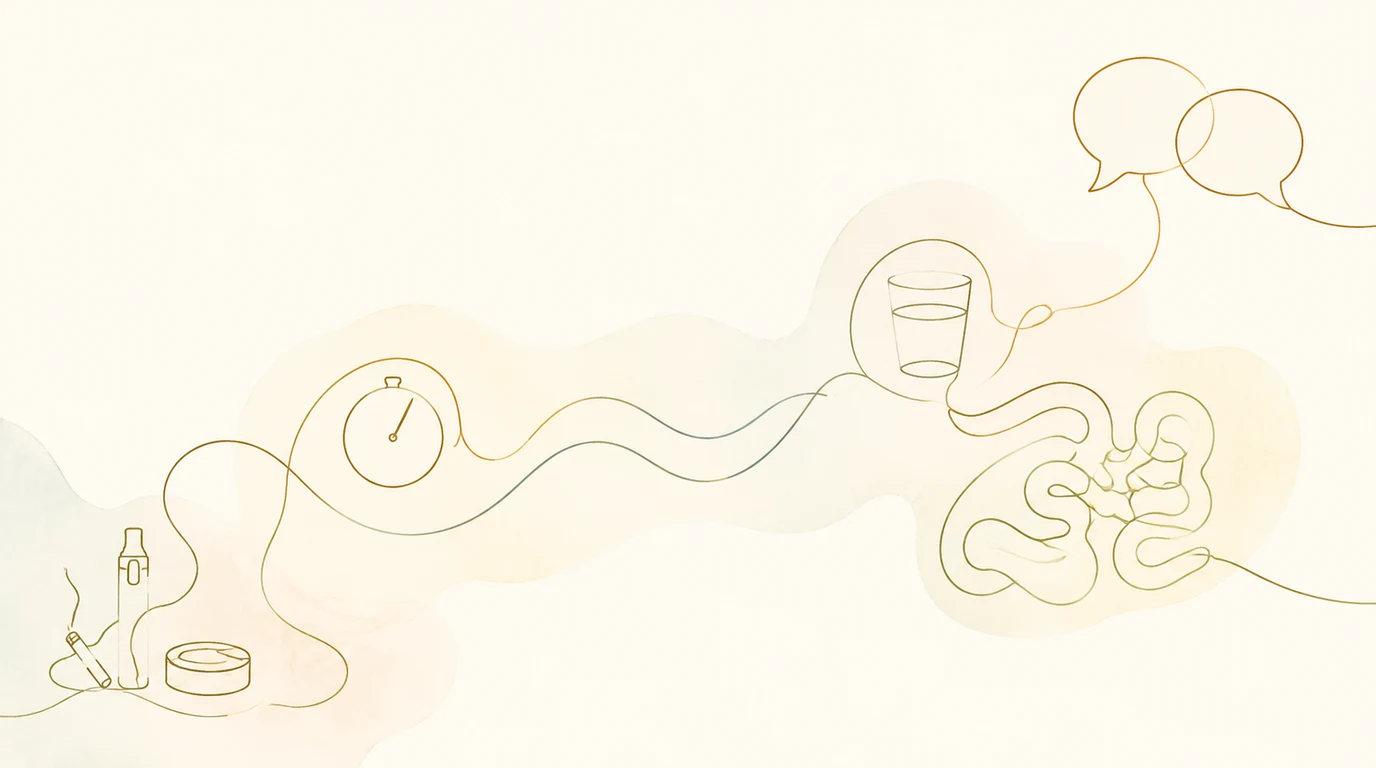
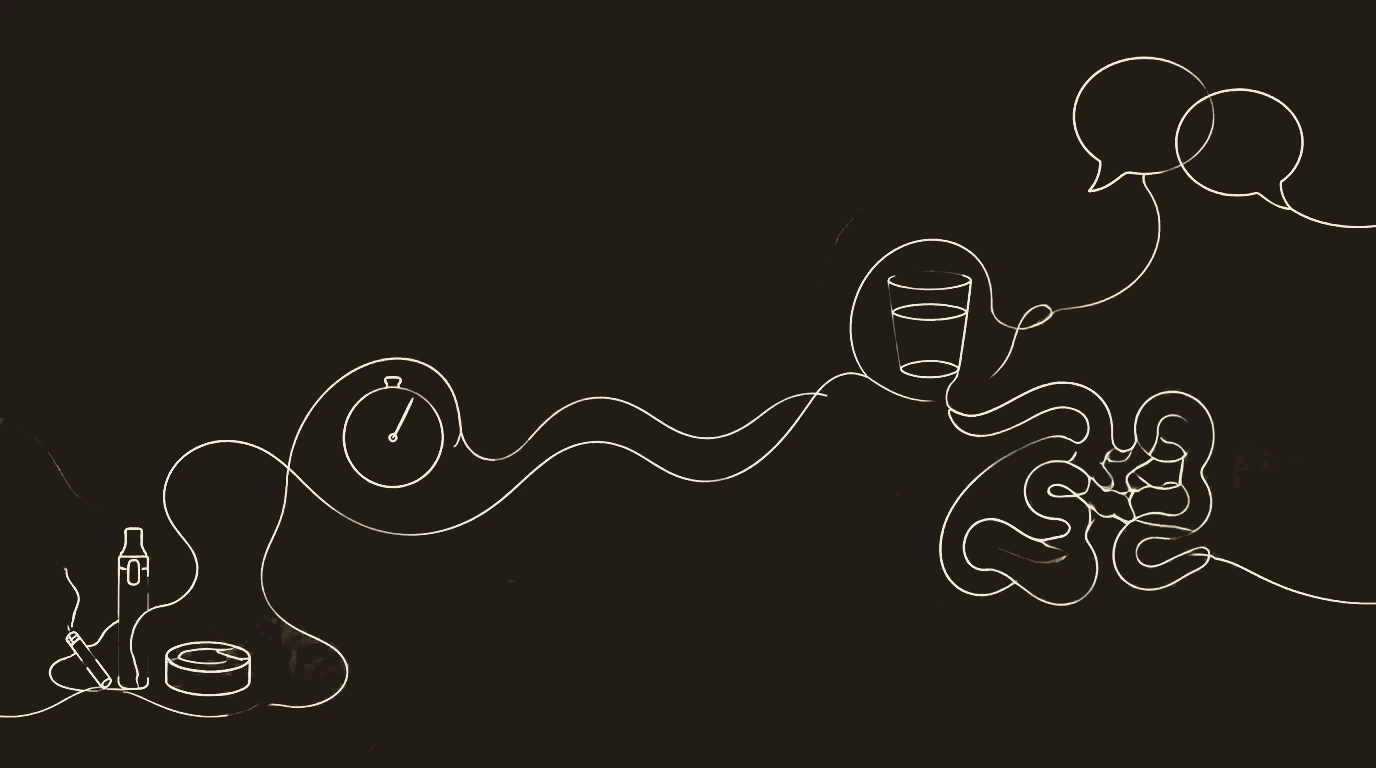
The 5 Ds for nicotine cravings provide one short sequence for the moment when using nicotine feels immediately available. You delay the decision, take several slow breaths, drink water, distract yourself with a defined action, and discuss the craving with someone when support is available.
The Australian Government teaches four Ds: delay, deep breathe, distract, and drink water (Australian Government Department of Health, 2023). World Health Organization patient-education material presents five Ds: delay, drink water, deep breathing, do something different, and discuss (WHO Regional Office for Europe, 2006). The lists vary between programs. This guide uses delay, deep breathe, drink water, distract, and discuss, with distract as the activity step.
The sequence can be used for cigarette, vape, nicotine-pouch, and other nicotine cravings. The complete guide to nicotine cravings and triggers covers why cravings happen, how to map them, and how long they can last. This page stays with the next few minutes.
Key takeaways
- Use one prepared sequence: delay, deep breathe, drink water, distract, and discuss
- Start the first action as soon as you notice the craving
- Give every D a concrete detail, such as a timer length, breathing count, activity, and person
- Repeat the sequence or move to a safer location when the craving remains strong
- Review the response after the craving so the next version fits the situation better
What the evidence says about the 5 Ds
The 5 Ds are widely used in tobacco-cessation education. Direct trial evidence for the complete mnemonic is limited. A smoking-cessation pilot paper described the established four-D version and found no evidence that confirmed or refuted the bundle itself (Al-Chalabi et al., 2008). The list organizes common coping actions into an easy sequence. Its effect varies between people and situations.
Research on individual components provides additional context. A small controlled study found that scheduled deep breathing reduced cigarette craving and some negative withdrawal symptoms during brief abstinence (McClernon et al., 2004). Smoking-cessation research also uses distraction and relaxation as momentary craving-management tools. Studies differ in intervention design and certainty (Herbec et al., 2021).
A quick response creates distance from the product and keeps the next action compatible with your quit plan.
The sequence may lower the intensity of a craving, occupy the period while it changes, or help you reach a safer setting. Some cravings stay strong, return soon, or reflect broader withdrawal. You can repeat the steps, leave the setting, contact support, or use the treatment plan already arranged with a clinician or pharmacist.
D1: delay the nicotine decision
Delay creates a defined period between the craving and nicotine use. Set a timer for five minutes. During that time, postpone actions that move you toward the product: opening the drawer, taking out the device, visiting the store, asking someone for nicotine, or placing an order.
Use plain wording for the timer, such as: "I will check again when the timer ends." The delay concerns the immediate action. Questions about the rest of the day can wait until this interval ends.
Make the delay physically clear when possible:
- put down keys, a wallet, or a phone if they lead toward a purchase
- move the nicotine product out of your hand or direct reach
- step away from the person or place where it is available
- begin walking toward a nicotine-free location
- keep the timer visible while you start the remaining Ds
Five minutes gives you a practical first interval. Cravings vary between people, products, and situations. When the timer ends, rate the craving briefly as lower, similar, or stronger. If it remains strong, repeat the sequence for another short interval or leave the setting.
D2: deep breathe at a steady pace
Use slow, comfortable breaths during the delay. Try this simple pattern:
- Let your shoulders lower.
- Breathe in gently through your nose.
- Breathe out slowly through your mouth.
- Repeat five times without forcing a very deep breath.
The breathing step gives you a physical task that is available in most settings. It may also help with tension that accompanies the craving. Controlled deep breathing reduced craving and negative affect in a preliminary laboratory study of adults who smoked and had abstained for four hours (McClernon et al., 2004). The study was small and concerned cigarettes, so it supports a modest claim about a brief coping action.
If slow breathing makes you lightheaded or uncomfortable, return to your normal breathing and continue with another step. You can count objects in the room, walk, or take a sip of water. The sequence is flexible enough to fit your body and location.
D3: drink water slowly
Take several slow sips of water. Notice the temperature and the act of swallowing. A bottle or glass also gives your hand and mouth a neutral task when nicotine use normally involves holding, inhaling, chewing, or placing something under the lip.
Water is included in many four-D and five-D public-health versions. Direct evidence that water independently reduces nicotine craving is limited. Its role in this sequence is practical: it occupies a short part of the delay, changes the sensory moment, and may move you toward a kitchen, water fountain, or other place where the product is less accessible.
Prepare this step around your common settings:
- keep water on the desk if cravings appear during work
- take a bottle for driving or commuting
- order water early in a social setting
- place a glass near the location where you begin the morning
- refill the bottle during the delay if movement would help
Choose another suitable drink when water is unavailable and the drink is compatible with your quit plan. Alcohol can be a strong cue for some people, and caffeine may be tied to a familiar nicotine routine. Your trigger map can identify whether either one needs a separate plan.
D4: distract with one defined action
Choose an activity that takes attention and lasts at least as long as the timer. Keep the task small enough to begin immediately. Examples include:
- walk to another room, floor, or block
- wash a few dishes or wipe a surface
- complete one short game, puzzle, or calculation
- listen to one song while reading the lyrics or following the rhythm
- chew gum or eat a prepared snack if an oral action is useful
- organize one drawer, bag, or section of a desk
- message someone about an ordinary topic
- hold a cold object or wash your hands with cool water
The chosen activity should reduce access as well as occupy attention. A phone game may help at home and may be unsafe while driving. A walk may work at an office and may lead past the usual shop during a commute. Pick the action that fits the setting.
Distraction and relaxation techniques are used in craving-management interventions, and brief physical activity has shown short-term effects on cigarette cravings in experimental research. The evidence base covers many different techniques. Results vary among activities and people (Herbec et al., 2021). Prepare two options for each frequent setting. This keeps another activity available when the first one is blocked.
D5: discuss the craving with someone
Contact a person who understands the immediate request. The conversation can be short. You might say:
- "I have a strong nicotine craving. Can you stay on the phone for five minutes?"
- "Can you talk with me while I leave the store?"
- "Please keep nicotine away from me while I get through this moment."
- "Can I message you again when the timer ends?"
Discussion may also mean sending a message to a quitline, counsellor, recovery contact, or supportive community when that option is available. Keep urgent safety concerns for an appropriate crisis or medical service.
Daily-diary research in couples who were both trying to stop smoking found that higher-than-usual support seeking was associated with fewer cigarettes smoked on the same day. The association between craving and smoking was also weaker for women on days with more support seeking (Schwaninger et al., 2022). The observational design leaves the effect of one message uncertain. Contact still has a useful role within a coping sequence.
If no one is available, write a short note with three facts: where you are, what made nicotine available, and what you will do until the next timer ends. Then continue with delay, breathing, water, and distraction. The fifth D can be added when contact becomes possible.
Put the five steps into one short sequence
Prepare a version that you can use without searching for instructions. A complete sequence may look like this:
- Delay: set a five-minute timer and move away from the nicotine product.
- Deep breathe: take five slow, comfortable breaths.
- Drink water: take several sips and refill the glass or bottle if useful.
- Distract: begin one preselected activity for the rest of the timer.
- Discuss: send one direct message or make a short call.
The steps can overlap. You can walk while talking, sip water during the call, or breathe slowly while the timer runs. Keep the order when it helps memory and change it when the setting requires a faster safety or access decision.
Store the compact version where you will see it, such as a phone note, wallet card, pinned support message, or paper copy near a desk or car keys. Include the actual details: "five minutes, five breaths, cold water, walk around the building, text Sam." A list of five labels may be difficult to translate into action during a strong craving.
Adapt the 5 Ds to the situation
The framework stays the same while the actions change.
At work
Set the timer, leave the area where nicotine is available, breathe while walking to get water, complete a small task away from the cue, and message your support person. If nicotine normally marks a break, keep the break length and use a nicotine-free location.
While driving
Keep your attention on the road. Continue driving to a safe stopping place, use ordinary comfortable breathing, sip water only when safe, choose audio as the distraction, and use hands-free contact where legal and safe. Phone tasks and complicated breathing counts can wait until the vehicle stops.
In a store or social setting
Move away from the display, person, or group offering nicotine. Start the timer as you leave the immediate area, get water, focus on a short task or conversation, and tell a supportive person what is happening. If alcohol or social pressure is part of the situation, leaving may be the clearest next action.
When the craving remains strong
At the end of the timer, check three things:
- Intensity: is the craving lower, similar, or stronger?
- Access: can you still reach or buy nicotine easily?
- Capacity: can you repeat the sequence safely by yourself?
For a lower craving, continue the distraction or return to the next planned activity. For a similar craving, repeat the five steps with a longer distraction or a different location. For a stronger craving, increase distance from the product and contact support. Follow any medication or cessation-treatment directions already established with a clinician or pharmacist.
Seek urgent medical or crisis help for symptoms that create an immediate safety concern. The nicotine withdrawal symptom guide covers the broader symptom timeline and signs that deserve professional attention.
Review the sequence after the craving
Once the immediate period has passed, record only what will help next time:
- where the craving happened
- which nicotine product was available
- the first D you used
- which action helped you create distance
- which step was unavailable or impractical
- one detail to prepare before the next similar situation
This is a brief practical review. Broader work on sensory, routine, emotional, social, and access cues belongs in your trigger map. If a nicotine use occurred, remove the remaining access and use the separate setback plan when it is available.
Prepare the next version in one line: delay for __ minutes, breathe __ times, drink __, do __, contact __. That line gives the next craving a ready sequence while leaving room to adapt it to the actual setting.