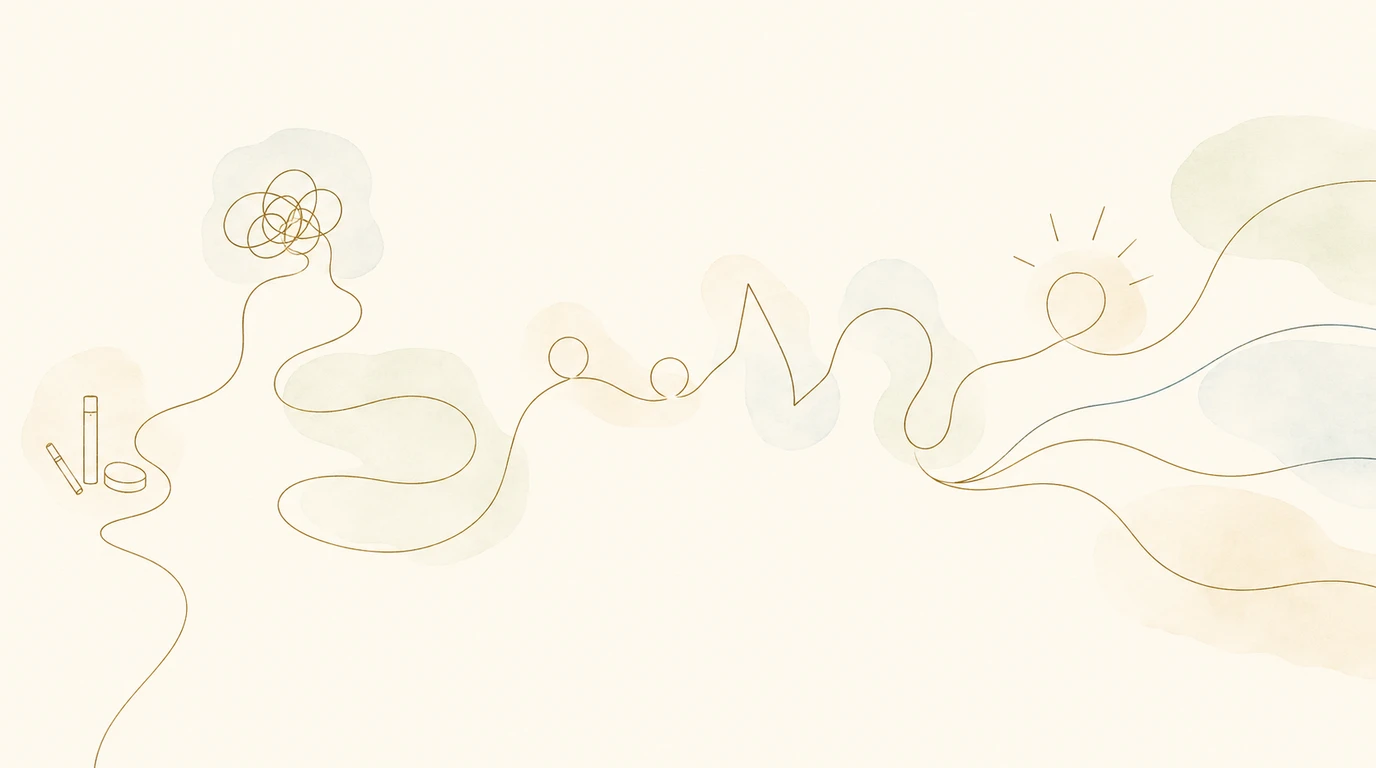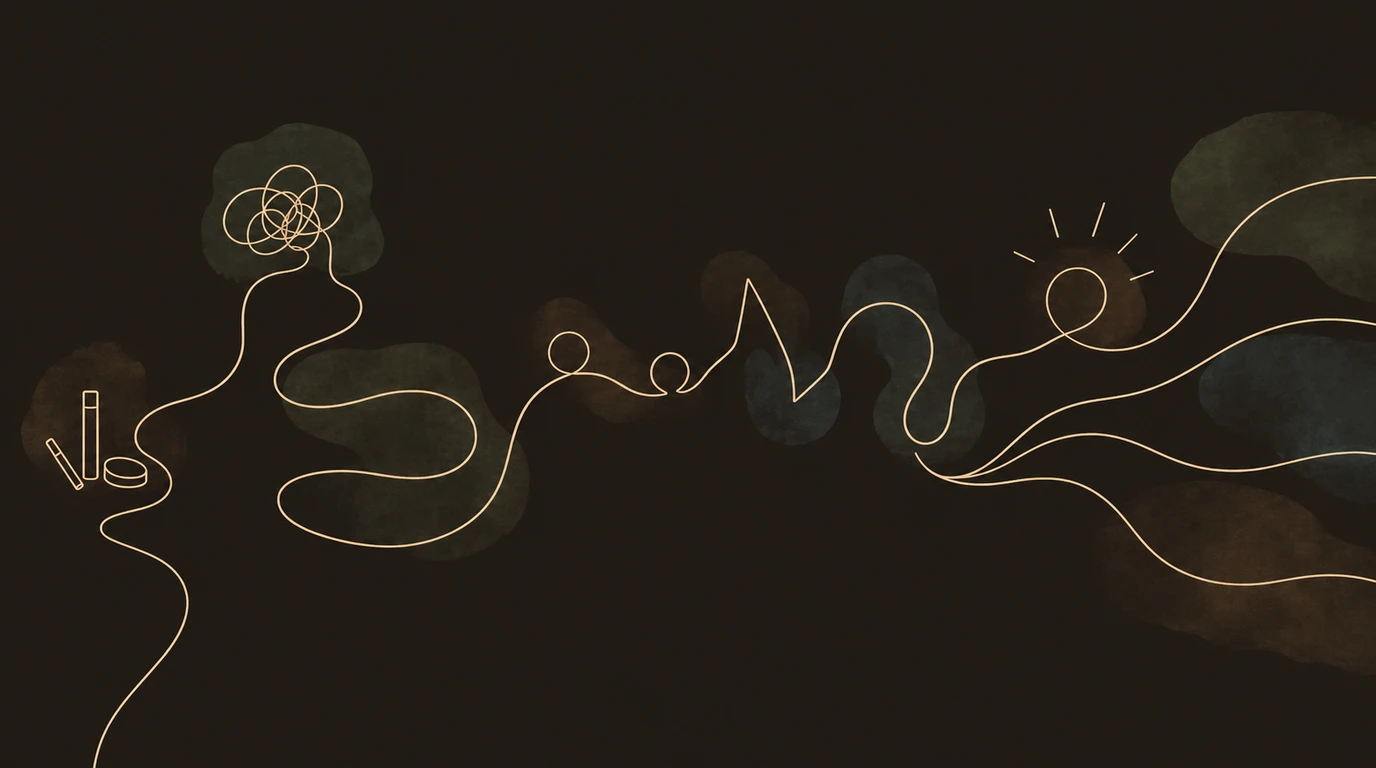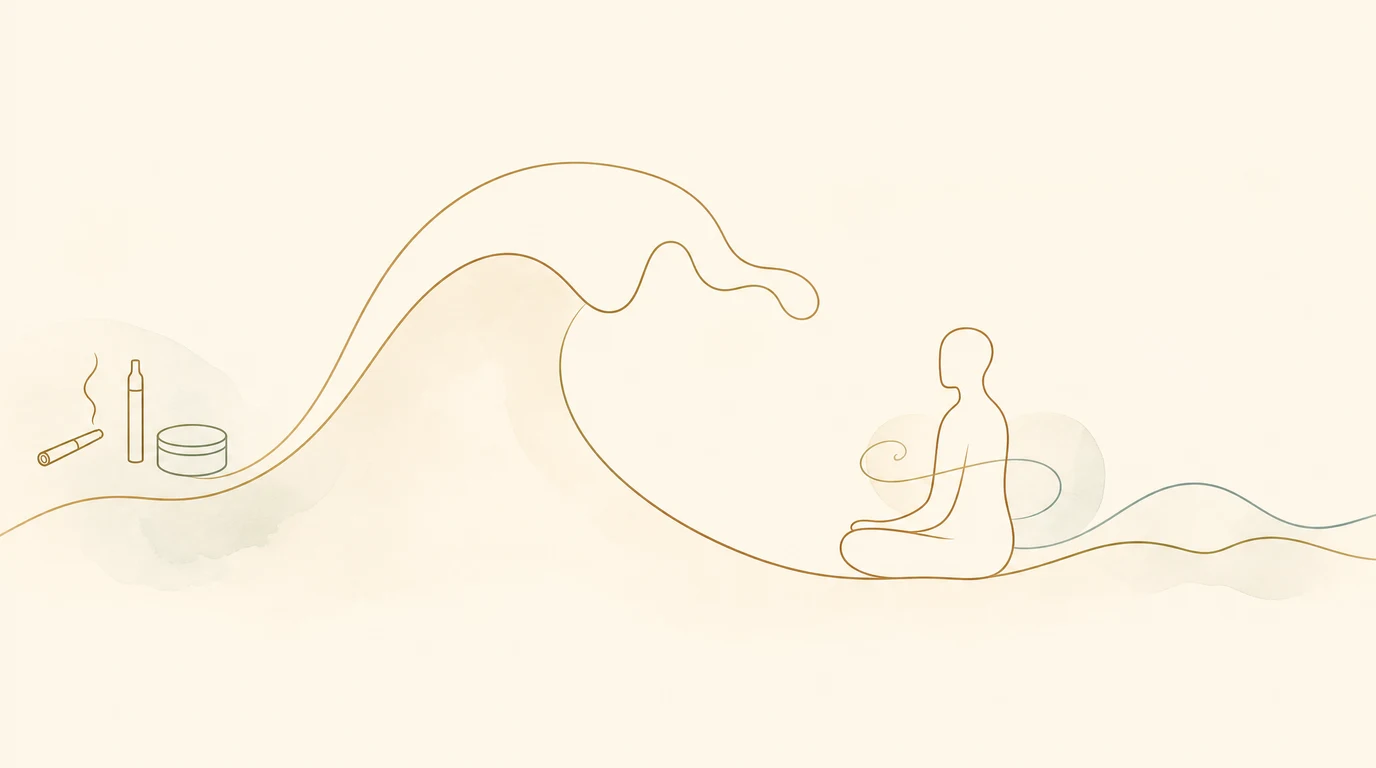
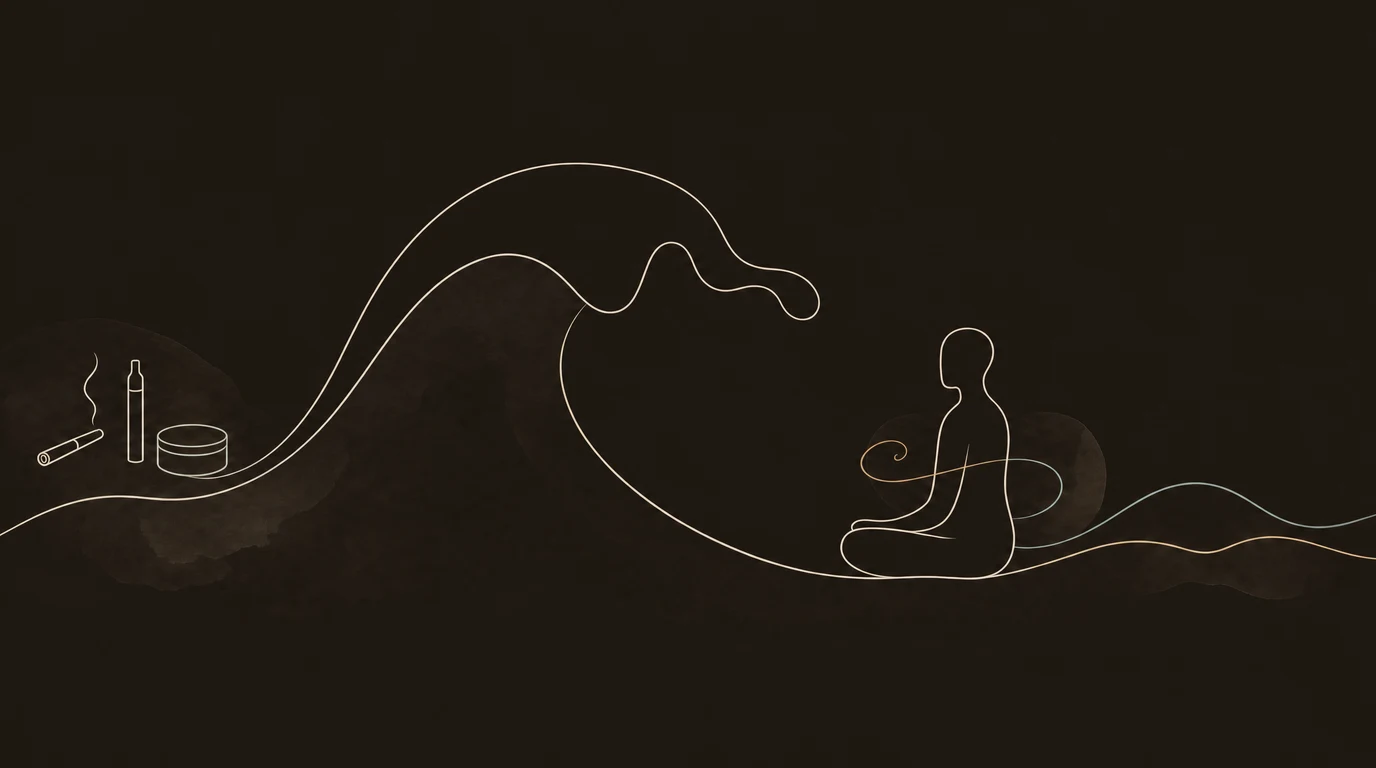
Urge surfing for nicotine cravings is a short mindfulness practice for observing what happens between wanting nicotine and acting on that desire. You notice body sensations, thoughts, and movement impulses for ten minutes, then choose the next useful action.
The timer creates one defined observation period. Craving duration remains variable. The practice also allows every outcome: intensity may fall, stay similar, rise, move to another part of the body, or return later.
This guide takes you through one complete ten-minute practice. The nicotine cravings and triggers guide covers the broader work of identifying sensory, routine, emotional, and social cues. The 5 Ds for nicotine cravings offers an action-based response when distraction, water, movement, or contact feels more useful.
Key takeaways
- Use ten minutes as an observation period; craving end time remains variable
- Separate body sensations, thoughts, and action impulses so the experience becomes easier to describe
- Return to one physical anchor whenever attention gets pulled into planning or mental debate
- Check intensity at the beginning and end, and record the number as observed
- Finish with a deliberate next step based on intensity, access to nicotine, and available support
What urge surfing means
Urge surfing applies mindful attention to a nicotine craving. The wave language describes change: sensations can build, shift, pulse, flatten, or fade. Some experiences stay fairly steady during a short practice. Observation is still possible when the pattern feels flat or unsettled.
The practice has three main parts:
- Body sensations: pressure, warmth, tingling, tightness, dryness, restlessness, or another physical quality
- Thoughts: images, predictions, memories, reasons to use, and plans for getting nicotine
- Action impulses: reaching, standing up, opening an app, checking a pocket, walking toward a shop, or asking someone for nicotine
Naming these parts can create a small pause before action. In a randomized study of 123 college students who smoked, the instruction and control groups reported similar immediate craving intensity. Participants who received brief urge-surfing instructions smoked fewer cigarettes during the following seven days (Bowen and Marlatt, 2009). The result suggests that a practice can affect a person's response even when the craving remains noticeable.
A laboratory study of 47 treatment-seeking smokers found that mindful attention during smoking-cue exposure reduced self-reported craving and activity in a brain region involved in cue reactivity (Westbrook et al., 2013). These studies used cigarettes and controlled settings. They provide preliminary support for mindful observation, with limited evidence for this exact ten-minute sequence or for newer nicotine products.
Prepare the practice
Choose a place where you can safely give the exercise ten minutes. If you are driving, operating equipment, crossing a street, or handling another task that needs full attention, wait until you are safely stopped.
Then prepare four details:
- Create a little distance from nicotine. Put the product down or move it beyond immediate reach. Close a shopping or delivery screen. Stay where leaving for nicotine requires a separate decision.
- Set a ten-minute timer. Use a quiet tone when possible. Keep the screen face down after starting it.
- Choose an anchor. Pick the contact of your feet with the floor, your hands resting together, or sounds in the room. Ordinary breathing can also serve as the anchor.
- Record a starting intensity. Use a 0 to 10 scale, where 0 means an absence of current pull and 10 means the strongest pull you can imagine. The number is a snapshot for this moment.
Sit, stand, or walk slowly in a safe space. Keep your eyes open or softly lowered. If focusing on breathing feels uncomfortable, use your feet, hands, or surrounding sounds throughout the practice.
Minutes 0 to 2: settle and name what is present
Start by feeling the chosen anchor for two or three ordinary breaths. Notice pressure, temperature, texture, or sound. Let your breathing find its own pace.
Use a plain sentence to name the experience: "A nicotine craving is here." Then ask three short questions:
- What do I feel in my body?
- What thought is repeating?
- What action does my body want to begin?
Give each answer a few words. For example: "tight jaw, image of the vape, hand wants to check my pocket." Specific descriptions keep the exercise connected to current experience.
Attention will move. Each time you notice planning, arguing, or replaying the cue, label it briefly as "thinking" or "planning." Return to the anchor, then observe the craving again.
Minutes 2 to 5: map the body sensations
Bring attention to the area where the craving feels clearest. It may be in the mouth, throat, chest, stomach, jaw, hands, face, or legs. It may also feel like general restlessness whose center is difficult to locate.
Describe the sensation through neutral qualities:
- location and size
- pressure, tightness, warmth, coolness, dryness, tingling, or movement
- clear or diffuse edges
- steady, pulsing, spreading, contracting, or shifting
Stay with one area for two or three breaths, then check its edges. Notice whether the strongest point has moved. If another sensation becomes clearer, follow it and describe that area.
Keep the language close to sensation. "Warm pressure under my ribs" gives you an observation. "I need nicotine to make this stop" is a thought, which you can label during the next part of the practice.
If the physical experience feels mild, observe the mildness. If it feels intense, narrow attention to a small area or return to the anchor for several breaths. The practice can move back and forth between the craving and the anchor.
Minutes 5 to 8: notice thoughts and action impulses
Shift attention to the mental and behavioral parts of the craving. A thought may appear as words, an image, a memory of relief, or a prediction about the next few minutes. Label the form in a short phrase:
- "image of using"
- "thought about relief"
- "plan to buy nicotine"
- "memory of the usual break"
- "prediction that this will keep growing"
Then notice the related action impulse. Your fingers may tense, your body may lean forward, or your attention may scan the room for the product. Observe the first physical movement and pause the sequence there. Relax your hand or return it to your lap if that helps you stay in place.
Move through a simple loop for these three minutes:
- Notice the thought or image.
- Give it a brief label.
- Notice the action impulse in the body.
- Return to the anchor.
- Check the craving again.
Let each thought enter awareness, describe it, and watch what follows. If the mind begins a long debate, use the single label "thinking" and return to physical contact with the floor or chair.
Minutes 8 to 10: check what changed and choose your next action
During the final two minutes, widen attention to your whole body and the room around you. Take in the anchor, the craving, and the surrounding environment together.
Rate the current intensity from 0 to 10. Compare it with the starting number and describe the direction: lower, similar, higher, or difficult to rate. Also record one concrete change, such as:
- the sensation moved from the throat to the jaw
- the pressure became less sharp
- the thought returned several times with longer gaps
- the action impulse stayed strong
- the craving rose after hearing or seeing a cue
Now check three practical facts:
- Intensity: how strong is the current pull?
- Access: how easily can you reach, buy, or ask for nicotine?
- Capacity: do you have enough attention to continue observing safely?
Choose what to do next. You can repeat the practice, begin a 5-D response, leave the setting, contact a supportive person, resume a planned activity, or follow the cessation treatment plan already arranged with a clinician or pharmacist.
If the craving becomes stronger
A rising craving gives you information for that decision. Open your eyes fully, name five objects you can see, and feel both feet on the floor. Move farther from the nicotine product or the route used to obtain it. Then choose an active response or contact support.
You can also end the timer early when observation is adding strain, the setting becomes unsafe, or another responsibility needs your full attention. The 5 Ds guide gives a prepared sequence for delay, breathing, water, distraction, and discussion.
Strong or recurring cravings can also be part of broader withdrawal. The nicotine withdrawal symptom guide explains the usual symptom pattern and reasons to seek medical help. Follow the instructions for any cessation medication or nicotine-replacement treatment you are using.
What the research can support
Direct studies of urge surfing for smoking are small. They also use different instructions, cue exposures, participant groups, and follow-up periods. The 2009 randomized study found fewer cigarettes smoked later and similar immediate craving ratings between groups (Bowen and Marlatt, 2009). A six-minute mindfulness experiment with 91 Australian students who smoked also reported less smoking during the following week after a later cue exposure (Chan et al., 2021).
Broader mindfulness research remains mixed. A Cochrane review covering 21 studies and 8,186 participants found unclear evidence that mindfulness-based smoking-cessation programs improve quit rates, with low or very low certainty for the main comparisons (Jackson et al., 2022). A smartphone trial found similar six-month abstinence between groups. Greater training completion was associated with a weaker link between craving and cigarettes smoked (Garrison et al., 2020).
The evidence supports modest expectations. Urge surfing is one coping practice. It may help you observe the craving, reduce cue reactivity, or create time before action. Research on this exact ten-minute structure as a stand-alone quitting treatment is still needed. Established cessation support and medication can remain part of the same plan.
Keep one short record
After the practice, write one line with four details:
Start _/10, end _/10, main change _, next action _.
This record tracks the practice itself. A broader trigger map can be completed separately. After several uses, review whether a particular anchor, location, or next action makes the exercise easier to complete.
Match the response to the moment. Observation, movement, distance, and contact can each support the same nicotine recovery plan.