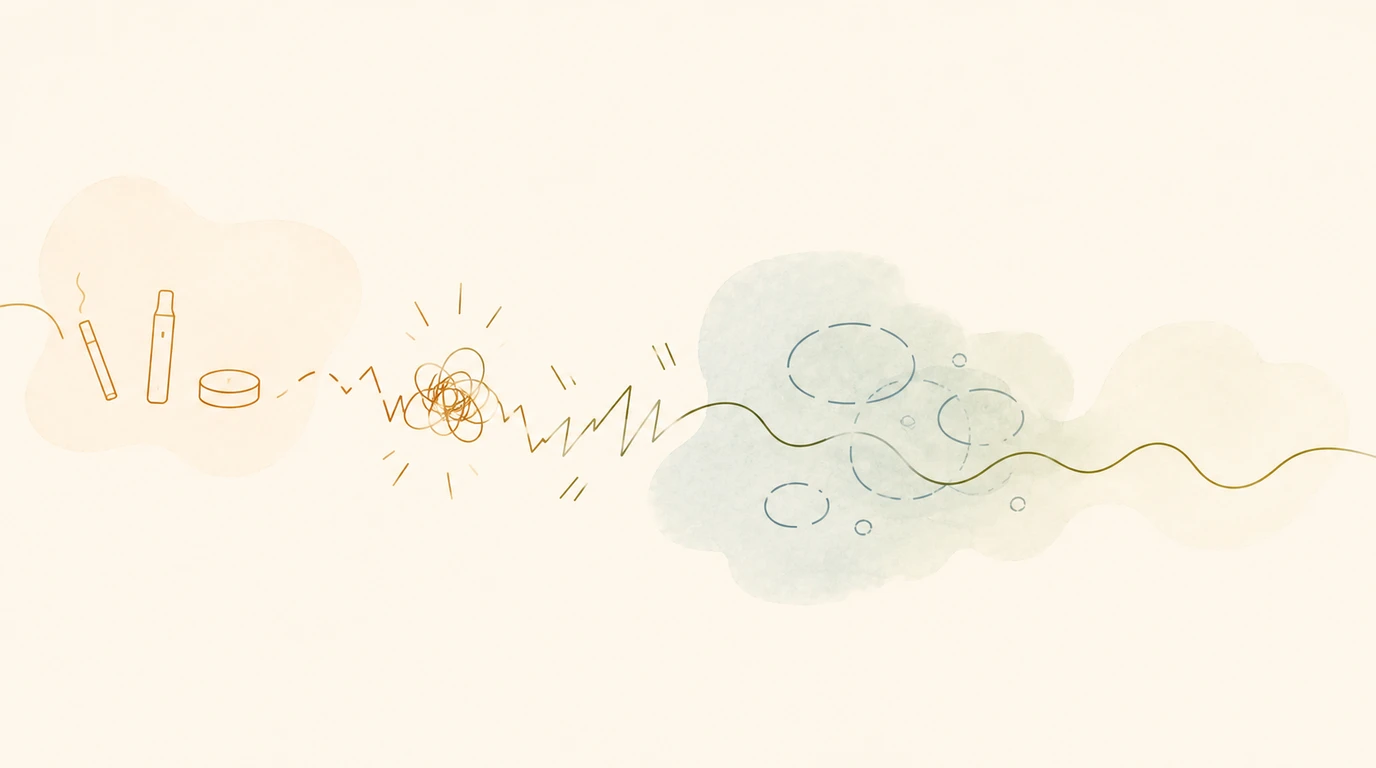

Low mood can appear after you stop cigarettes, vaping, nicotine pouches, or another nicotine product. You may feel sad, empty, flat, tearful, less interested in ordinary activities, or slower to begin the day. The timing may suggest a withdrawal effect. Identifying the cause requires a wider view of your symptoms and circumstances.
Depression is a broader clinical pattern. Duration, symptom range, severity, previous episodes, and the effect on daily life all help a clinician understand what is happening. A quit attempt can also coincide with sleep loss, relationship strain, work pressure, grief, medication changes, alcohol or other drug use, and health problems.
This guide helps you monitor the change, support basic daily function, and choose an appropriate level of help. The complete nicotine withdrawal guide covers the wider symptom timeline. Here, the focus stays on low mood, possible depression, and safety.
Key takeaways
- Early low mood can be part of nicotine withdrawal, and the pattern varies between people and products
- Track timing, symptom range, and daily function together
- A previous depressive episode or current mental-health treatment is a reason to arrange support early
- Persistent, worsening, or disruptive symptoms deserve professional assessment
- Thoughts of suicide, self-harm, or being unable to stay safe require immediate help
Low mood can appear during nicotine withdrawal
Depressed or sad mood is a recognized nicotine withdrawal symptom. In a study of 147 people who stopped smoking while attending a cessation clinic, ratings of depression, irritability, concentration difficulty, and restlessness peaked during the first week or two and returned to baseline by week four on average (West et al., 1989). The study was small, used weekly ratings, and involved people using different amounts of nicotine gum, so its timeline describes an average across that group. Individual timelines can differ.
Evidence from other nicotine products is thinner. In a clinical study of 109 former smokers who used e-cigarettes daily, six days of verified vaping abstinence increased several withdrawal symptoms, including a small average increase in feeling depressed or sad (Hughes et al., 2020). Half of the participants completed a full week of abstinence, and the sample consisted of former smokers, which limits how widely the result applies.
Low mood during withdrawal may occur alongside irritability, anxiety, restlessness, poor concentration, sleep changes, fatigue, and cravings. The dedicated guide to irritability, anxiety, and brain fog during nicotine withdrawal covers that acute cluster. Recording the symptoms separately makes it easier to see whether mood is moving with the rest of withdrawal or following its own course.
Look at timing, range, and daily function
Three questions create a useful first picture.
When did the change begin? Record the date, your last nicotine use, later nicotine use, and any treatment changes. Mood that shifts soon after stopping may fit an early withdrawal pattern. Mood that began before the quit date, appears much later, or follows another major event may have additional causes.
Which symptoms are present? Note sadness, emptiness, loss of interest or pleasure, hopelessness, guilt, slowed or agitated movement, concentration changes, sleep, appetite, energy, and thoughts about death or self-harm. A single symptom and a broad cluster provide different information.
What has become harder to do? Pay attention to getting out of bed, washing, eating, attending work or school, caring for children, replying to people, managing medicines, and completing basic tasks. Function can reveal severity even when finding a precise mood word feels difficult.
The National Institute of Mental Health describes major depression as a pattern that usually includes depressed mood or loss of interest most of the day, nearly every day, for at least two weeks, along with other symptoms and meaningful distress or disruption (NIMH, 2024). You can contact a professional at any point. Severe symptoms, rapid worsening, or impaired function justify earlier help.
Keep a short mood and function record
Use one brief entry at roughly the same time each day. A compact record is easier to maintain during low energy and gives a clinician concrete information if you ask for help.
Record:
- Mood from 1 to 5, using the same scale each day
- Interest or pleasure from 1 to 5
- Sleep duration and sleep quality
- Whether you ate regular meals and drank enough fluids
- One basic task and whether you completed it
- Contact with another person
- Nicotine use, if any, and any cessation treatment used as directed
- Alcohol, cannabis, or other drug use
- Any thoughts of death, suicide, or self-harm
Add one sentence about context, such as a conflict, deadline, illness, menstrual-cycle change, medication change, or long period alone. Keep the record descriptive. It exists to show movement and function, without grading the quality of your recovery.
Review the entries every few days. Look for direction: improving, stable, fluctuating, or worsening. Also look for a widening effect on sleep, food, hygiene, responsibilities, and contact with other people.
Protect basic function while mood is low
Low mood can make a full self-care plan feel unmanageable. Choose a small set of anchors that protect the day while you monitor the pattern or wait for care.
- Use a fixed wake-up point. Get out of bed within a planned window, open the curtains, and move to another room when possible.
- Plan simple food and fluids. Keep options available that require little preparation.
- Choose one necessary task. Define the smallest complete version, such as answering one important message or taking a shower.
- Include brief movement. A short walk, gentle stretching, or another familiar activity can add structure without becoming a performance target.
- Keep one human contact. Tell a trusted person that your mood has dropped and agree on the next contact time.
- Reduce avoidable isolation. Work in a shared room, visit a familiar public place, or stay near someone you trust when being alone makes the mood heavier.
Sleep disruption can deepen fatigue and make mood harder to interpret. Track both together and use the practical steps in the guide to sleep and fatigue after quitting nicotine. The longer nicotine stress-and-anxiety cycle has its own patterns and coping work in the nicotine, stress, and anxiety guide.
These anchors support observation and daily safety. Persistent depression usually needs a fuller assessment and may need treatment.
Arrange early support when depression has been part of your history
A current or past depressive episode can shape the mood course during a quit attempt. In a one-year study of 1,000 people in an online smoking-cessation trial, a history of major depression predicted higher depressive symptoms over time regardless of smoking status. Smoking abstinence was associated with lower depressive symptoms at the follow-ups, including among participants with higher symptoms at baseline (Liu et al., 2021).
Before or early in the quit attempt, tell the professional who manages your mental-health care which nicotine products you use, your planned method, previous mood changes during quit attempts, and the support available at home. Keep taking prescribed medicines according to the current plan. Contact the prescriber before changing a dose or schedule.
You can prepare a concise use history, medicine list, symptom record, and question list with the guide to talking with a clinician or pharmacist about quitting nicotine. Ask who to contact if mood drops, how quickly they want to hear from you, and what follow-up is available.
Research on a new major depressive episode after smoking cessation remains uncertain. A review of seven empirical studies found wide incidence estimates and major methodological limitations, while a previous history of major depression appeared to identify a higher-risk group (Hughes, 2007). That uncertainty supports monitoring and early access to care, especially when depression has occurred before.
Know when low mood needs professional assessment
Contact a doctor, nurse practitioner, psychologist, psychiatrist, or other qualified mental-health professional when:
- Low mood persists, keeps returning, or worsens
- You have lost interest or pleasure across most activities
- Sleep, appetite, concentration, or energy changes are substantial
- Work, school, caregiving, hygiene, meals, or medicines are becoming difficult to manage
- Hopelessness, worthlessness, or intense guilt is increasing
- People close to you notice a marked change
- You have a history of depression, bipolar disorder, psychosis, self-harm, or a suicide attempt
- A medicine or cessation treatment change occurred near the mood change
- Alcohol or other drug use is increasing
A professional can assess depression, withdrawal, sleep, medical conditions, medicines, and current stressors together. Bring your short record and the packaging or names of medicines and cessation aids. Explain the direction of change and its effect on daily life.
Get urgent help for danger signs
Seek immediate help if you have thoughts of suicide or self-harm, have made a plan, are preparing to act on it, feel unable to stay safe, or face an immediate danger. The NIMH lists new or escalating hopelessness, feeling trapped, unbearable pain, withdrawal from others, giving away possessions, saying goodbye, dangerous risk-taking, and extreme mood swings among warning signs that need prompt attention (NIMH, 2025).
In the United States or Canada, call or text 988. In another country, contact your local crisis line or emergency service. Ask a trusted person to stay with you or help you reach care. Call emergency services when the danger is immediate.
Tell the responder that you recently changed nicotine use, along with any medicines, alcohol or other drugs, past mental-health history, and access to anything you could use to harm yourself. Immediate support takes priority over analyzing whether withdrawal contributed.
Longer-term evidence is generally reassuring
Early discomfort and longer-term mental health follow different time scales. A 2021 systematic review found that smoking cessation was associated with improvements in depression, anxiety, and mixed anxiety-depression symptoms compared with continued smoking. The depression analysis included 34 studies and 7,156 participants, though the certainty for that outcome was very low because the observational evidence could still be affected by confounding (Taylor et al., 2021).
A later secondary analysis of a hospital-based smoking-cessation trial also found that continuous six-month abstinence was associated with lower depression and anxiety scores and lower odds of a positive screening result at six months (Nagawa et al., 2025). These studies concern cigarette smoking. Comparable long-term evidence for people quitting nicotine vaping or tobacco-free pouches remains limited.
The broad evidence supports continued cessation care alongside mental-health care. Your current symptoms still deserve attention on their own terms. Track the pattern, keep another person informed, and move to professional or urgent support as soon as the severity calls for it.