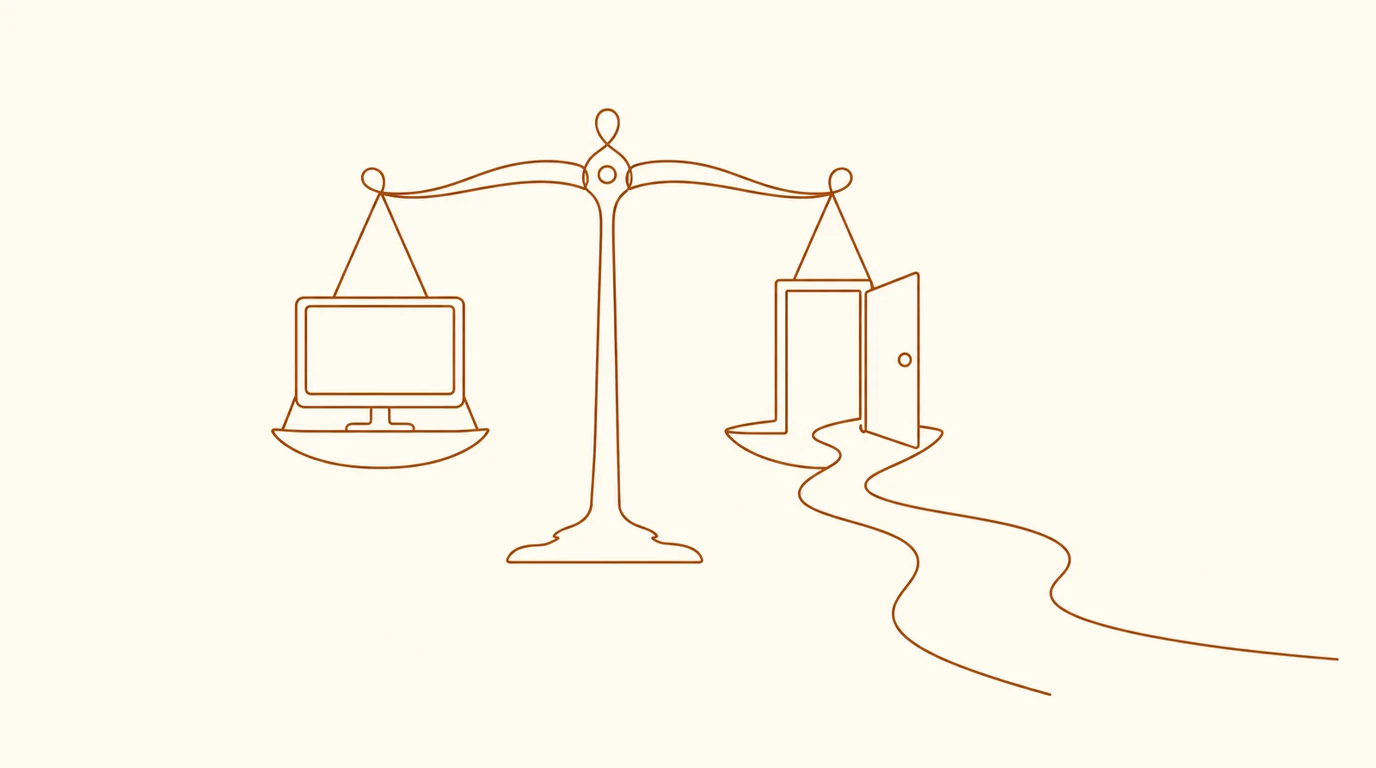
Can you watch porn in moderation? If porn has already become hard to control, the honest answer is usually no.
Some people use porn occasionally and do not experience obvious problems. This article is for the person asking the question because porn has already affected focus, mood, relationships, sex, honesty, self-respect, or the ability to stop.
In that situation, moderation often keeps the same loop alive: cue, search, novelty, arousal, objectification, release, shame or numbness, then another promise to keep it under control next time. The frequency may go down for a while, but the relationship to porn often stays the same.
Key takeaways
- If porn has become compulsive, moderation usually keeps the same cue, craving, novelty, and objectification pathway active
- The issue goes beyond dopamine and frequency; porn can also train a way of seeing people as material for arousal
- "Ethical porn" may address some production concerns, but it does not automatically make porn safe for recovery
- The best self-check is pattern-based: can you set a limit, keep it, stay honest, and feel clear afterward?
- A clean break gives recovery more room than trying to negotiate with the habit while it is still strong
Can you watch porn in moderation?
For someone without a compulsive pattern, moderation may be a personal choice. For someone in recovery, it is usually a loophole dressed as balance.
Compulsive sexual behavior disorder is described in the ICD-11 literature as a persistent failure to control intense, repetitive sexual urges or behaviors, with patterns such as excessive time spent, repeated unsuccessful attempts to reduce the behavior, continuing despite consequences, and distress or impairment (Kraus et al., 2022). Problematic pornography use is often discussed as one common expression of that wider clinical picture, although research still uses different labels and models (Antons et al., 2022).
That matters because the moderation question is usually asked after control has already become unreliable. If you have repeatedly decided to watch less, avoid certain categories, stop using private tabs, stop lying, stop late-night sessions, or stop after one video, frequency no longer explains the whole pattern. Your decisions do not hold when the cue is active.
That is why a clean break is usually clearer than a moderation plan. It removes the recurring argument about what counts, how much is allowed, and whether this session is still "controlled."
Why moderation is hard once the loop is active
Porn can become more than a file or a website. For many people, it becomes a learned sequence.
The sequence can start with stress, boredom, loneliness, rejection, fatigue, or a visual cue. Then comes searching, scanning, choosing, escalating, and chasing the feeling that the next click will be better. The I-PACE model of specific internet-use disorders describes how cue-reactivity, craving, reduced inhibitory control, and repeated reinforcement can help maintain addictive patterns involving internet pornography (Brand et al., 2016).
Porn-specific research points in the same direction. In a study of men seeking treatment for problematic pornography use, sexual cues were linked with ventral striatal activity, a reward-related response connected to anticipation and motivation (Gola et al., 2017). That does not prove that every person who watches porn is addicted. It supports the practical recovery point that sexual cues can become unusually powerful when porn use is already problematic.
Moderation keeps you close to those cues. You still search. You still select. You still train novelty. You still give the habit a door back in.
This is why "only once a week" can fail even when it sounds reasonable. The schedule may be moderate, while the internal pattern is unchanged.
The objectification part matters
Many recovery conversations focus on dopamine, streaks, and willpower. Those matter, and the picture is wider than that.
Porn also trains attention. It can teach the brain to scan people as body parts, categories, scenes, and possible sexual uses. A 2024 study of 1,342 adults found that greater pornography use frequency was associated with greater sexual objectification of others, and degrading-content preference was especially relevant for men's objectification of women (Bridges et al., 2024). A 2025 study of 1,272 heterosexual male consumers found that internet sex addiction predicted sexual objectification of women even after accounting for pornography viewing frequency (Novakova et al., 2025).
That is one reason moderation can be misleading. You may reduce the number of sessions while still practicing the same way of seeing: bodies as content, attraction as consumption, intimacy as performance, and people as material for private use.
If that pattern is part of what you want to change, the question becomes deeper than "Can I use a little?" It becomes: what does this keep training in me?
For more on this specific pattern, read how porn trains objectification and how to reverse it.
What about ethical porn?
Ethical porn is a common middle position. The idea is understandable: if the concern is exploitation, choose content that claims better consent, pay, working conditions, and production standards.
Those concerns are real, but they do not settle the recovery question. Recovery is about what the behavior does inside your life.
If you use ethical porn to escape stress, numb loneliness, chase novelty, edge around a boundary, compare bodies, avoid intimacy, or restart private objectification, it can keep the same compulsive loop alive. Research on pornography motivations has identified motives such as sexual pleasure, curiosity, emotional distraction or suppression, stress reduction, fantasy, boredom avoidance, and lack of sexual satisfaction, with some motives showing associations with problematic pornography use (Bothe et al., 2021).
In other words, the label on the content may change while the function stays familiar.
This is also why soft porn, thirst traps, erotic stories, OnlyFans, cam content, and social media feeds can matter during recovery. The objectification test for what counts as porn is often more useful than arguing over the platform label.
A practical moderation test
If you are still considering moderation, do not ask whether you can imagine a controlled version. Most people can imagine one.
Ask what usually happens in real life.
Use these questions:
- Can I set a clear limit before watching and follow it without bargaining?
- Can I stop after the planned amount without searching for more?
- Can I avoid categories, creators, accounts, or scenarios that I know escalate me?
- Can I tell the truth about it to the person who would reasonably be affected by it?
- Do I feel steady afterward, rather than ashamed, numb, anxious, restless, or pulled toward another session?
- Does it leave my relationship with real people more respectful and present?
- Does it make real intimacy easier, not harder?
- Does it avoid triggering comparison, performance pressure, or body insecurity?
- Does it stay separate from stress, loneliness, boredom, rejection, and avoidance?
- If I stopped again tomorrow, would I feel free, or would I feel deprived and preoccupied?
If several answers are no, moderation is probably a story the habit tells when abstinence starts working.
When a clean break is the better plan
A clean break is usually the better plan when porn has caused:
- Repeated failed attempts to stop or cut back
- Escalation into more intense, specific, or disturbing content
- Secrecy, lying, or hidden accounts
- Relationship conflict or loss of trust
- Sexual dysfunction, delayed orgasm, or needing porn fantasy during intimacy
- Strong comparison, shame, or self-hatred after watching
- Using porn to cope with stress, boredom, loneliness, or rejection
- Returning to porn after every "controlled" experiment
If that list feels familiar, start with abstinence rather than moderation. Use how to quit porn as the broader plan, porn urges and triggers to map the loop, and social media porn addiction if feeds keep pulling you back.
This does not require panic. A clean break can simply be a recovery experiment with enough honesty to work: no porn, no soft substitutes, no edge-case content, and no private bargaining for a fixed period.
What to aim for instead
Replacing moderation should not create fear of sexuality. Recovery should move you toward a healthier sexual baseline, more honesty, and better contact with real life.
That can include normal attraction, sexual thoughts that pass, partnered intimacy, and eventually a more grounded relationship with desire. Healthy sexuality after quitting porn explains that process in more detail.
The short version: you are trying to separate real desire from the porn loop. Real desire tends to be more connected to context, personhood, touch, emotion, and mutuality. The porn loop tends to be urgent, private, screen-based, novelty-driven, and disconnected from the person in front of you.
At first, that distinction may be blurry. It gets clearer when you stop feeding the old pattern.
The clearer answer
For a person who has never had a problem with porn, moderation is a personal question.
For a person who is trying to recover from compulsive porn use, moderation is usually the wrong target. It keeps the same cues close, gives the habit room to negotiate, and can preserve the objectifying attention pattern you are trying to weaken.
The better target is freedom from the loop: being able to feel stress without using porn, notice attraction without turning it into consumption, experience sex without comparison, and live without a private habit that keeps pulling you away from the person you want to become.