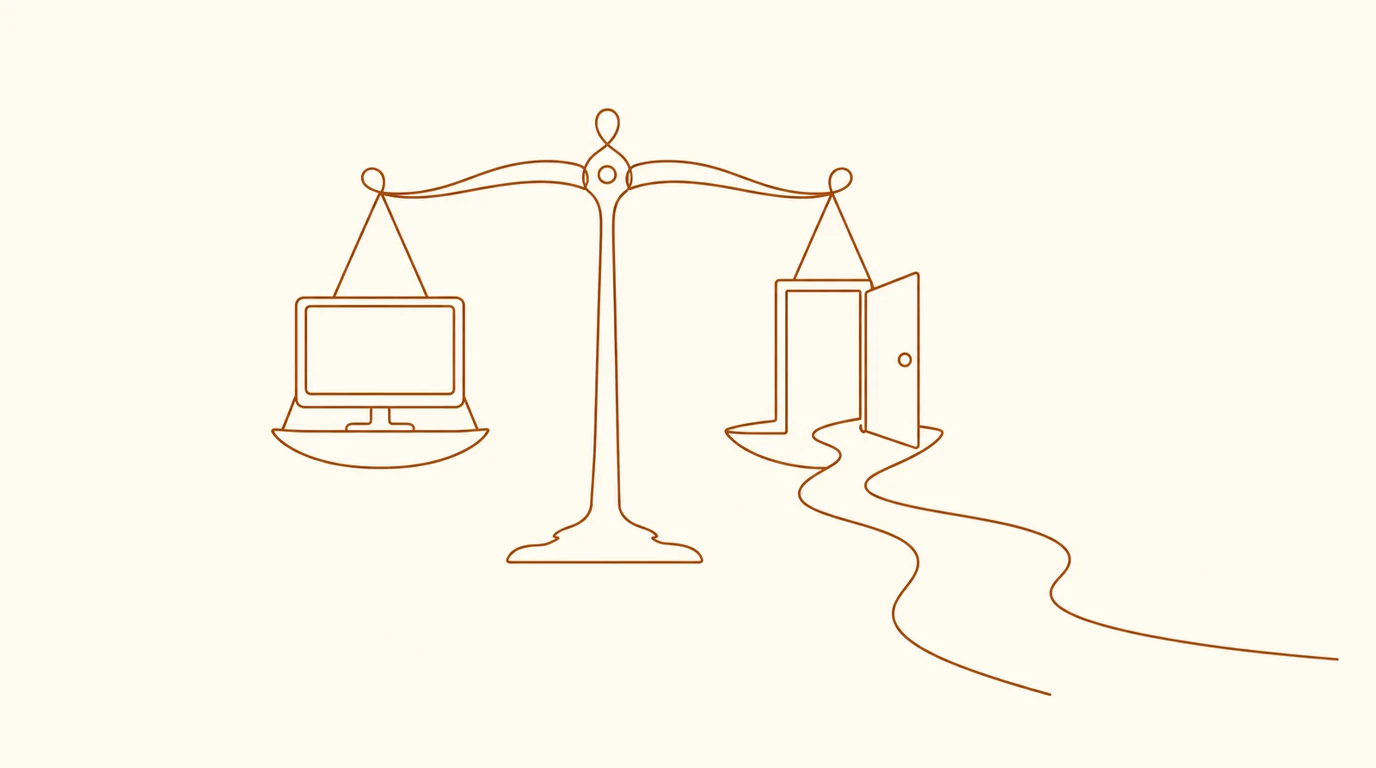
"Is OnlyFans cheating?" The question comes up in relationships constantly now, and there's rarely a clean answer. Some couples consider it harmless. Others see it as a deep betrayal. Most people wrestling with this question already sense that something about it feels different from watching a random video on a tube site.
That instinct is worth paying attention to. Instead of trying to settle a universal definition of cheating, it helps to look at the specific features of the behavior: secrecy, direct interaction, money, personalized content, and whether it violates the boundaries of the relationship.
Key takeaways
- OnlyFans differs from traditional porn because you're paying a specific person, you can interact with them directly, and the experience creates a parasocial relationship that mimics real intimacy
- Whether it qualifies as "cheating" depends on your relationship's boundaries, but hidden use is deception regardless of what label you give it
- OnlyFans is more addictive than free porn because it combines sexual content with financial sunk cost, the illusion of a personal connection, and an escalation loop through paid interactions
- The financial damage often becomes significant before people realize the extent of it, with monthly spending quietly climbing as the habit deepens
- Quitting requires more than willpower: deleting the account (not just unsubscribing), blocking access, and addressing the underlying need that OnlyFans was filling
Why OnlyFans feels different from regular porn
If you've watched free porn and also used OnlyFans, you already know they don't feel the same. The content might be similar, but the experience is fundamentally different. Understanding why helps explain both the addiction potential and the relationship damage.
You're paying a specific person. On a tube site, you're watching anonymous clips. On OnlyFans, you're financially supporting someone by name. You know their face. You might know details about their life. That financial transaction can create a sense of connection that anonymous viewing usually does not.
You can message them. This is the biggest shift. OnlyFans creators respond to DMs (or at least appear to). You can request specific content. You can receive personalized messages. The line between consuming content and having an interaction with another person gets blurry fast.
It creates a parasocial relationship. Parasocial relationships are one-sided connections where you feel like you know someone who doesn't actually know you. Research published in Scientific Reports found that people perceive strong parasocial relationships as more effective at meeting emotional needs than weak real-world ties, which helps explain why these connections feel so real. OnlyFans supercharges this dynamic. The creator posts personal updates, responds to your messages, remembers your name. Your brain starts filing this under "relationship," even though it's a transaction.
Custom content deepens the hook. When a creator makes content specifically for you, or appears to, it can create a stronger feeling of being noticed than mass-produced porn. That sense of being seen is powerful, and compulsive behaviors often attach themselves to real emotional needs.
The illusion of reciprocity. Free porn is clearly a one-way experience. OnlyFans creates the feeling that someone cares about you, wants to hear from you, and is excited when you subscribe. That illusion of mutual interest can make the behavior feel relational, which is why many partners experience it as a form of affair.
Is it cheating? That depends on your relationship
There's no universal definition of cheating that applies to every couple. Some relationships are fine with porn, some aren't. Some couples have discussed OnlyFans specifically, most haven't. The answer depends entirely on the boundaries you and your partner have agreed to (explicitly or implicitly).
That said, here are some honest realities worth sitting with.
Hidden use matters. You might debate the philosophical question of whether OnlyFans "counts" as cheating, but clearing your browser history, using a separate payment method, or making sure your partner never finds out points to a trust problem. Hidden use is deception, and deception damages relationships regardless of what label you use.
Many partners experience it as infidelity. Even if you see it as "just content," your partner may experience your OnlyFans use as you paying for a personal sexual relationship with someone else. Their feelings about it aren't wrong just because no physical contact occurred. How porn already affects relationships gets magnified when the porn becomes personal.
The "it's just like porn" argument has limits. There is a meaningful difference between watching a recorded scene and corresponding with a creator. Direct interaction, the financial relationship, and personalized content move OnlyFans beyond passive consumption and into something closer to an ongoing sexualized connection.
Some couples genuinely are fine with it. This is also true. If both partners have openly discussed it, both are comfortable, and neither feels pressured or hurt, then it's within the boundaries of your relationship. The problems start when it's hidden, when boundaries haven't been discussed, or when one partner's comfort is being ignored.
Why OnlyFans is more addictive than free porn
If you've found yourself addicted to OnlyFans and wondering why you can't stop, you're not dealing with a simple willpower problem. OnlyFans activates more reward pathways than traditional pornography, making the compulsion stronger and harder to break.
Financial sunk cost keeps you subscribed. Once you've spent money on a creator, your brain doesn't want that investment to feel wasted. You keep subscribing, keep tipping, keep buying custom content, partly because stopping would mean admitting the money is gone. This is the same psychological mechanism that keeps people gambling.
Parasocial attachment creates emotional dependency. When you follow a specific creator over weeks or months, your brain forms an attachment. You look forward to their posts. You feel something when they message you. Cutting off that connection triggers a version of the same withdrawal you'd feel ending a real relationship, even though the "relationship" was never mutual.
The novelty drip is perfectly calibrated. Free porn offers unlimited novelty, which can actually cause decision fatigue. OnlyFans delivers novelty in measured doses from creators you're already attached to. New post from someone you follow? That's a targeted dopamine hit that keeps pulling you back.
Escalation through paid interactions. Free porn escalates through increasingly extreme content. OnlyFans escalates through deeper financial and emotional investment: first a subscription, then tips, then custom content, then exclusive DMs. Each step feels like getting closer to something real, and each step costs more.
It fills an emotional gap. Many people who become addicted to OnlyFans aren't just seeking sexual content. They're seeking connection, validation, the feeling of being desired. OnlyFans provides a synthetic version of those things, which is why it hooks harder than anonymous pornography. If you've noticed that pattern in yourself, you're not alone, and it's worth understanding what need OnlyFans is actually serving.
The financial damage nobody talks about
The financial side of OnlyFans addiction gets less attention than the relationship side, but it can be equally destructive. Unlike free porn, OnlyFans costs money every time you engage, and the costs compound in ways that are easy to miss until you look at the total.
A single subscription might be $10 or $15 a month. But most people don't follow just one creator. Add tips, pay-per-view messages, custom content requests, and it's not unusual for monthly spending to reach hundreds of dollars. Some people spend thousands before they stop and calculate the real number.
Shame around spending can accelerate secrecy. The hidden behavior may involve both sexual content and financial decisions. If your boyfriend, husband, or partner is using OnlyFans, the financial impact may show up as unexplained charges, tighter budgets, or money that seems to disappear. The same applies if you're the one spending.
If you haven't already, go through your bank and card statements. Add up everything you've spent on OnlyFans. The total is almost always higher than you expect, and seeing that number is often the wake-up call that makes the problem feel real.
Signs OnlyFans has become a problem
Many people use OnlyFans without developing a compulsive pattern. If you recognize yourself in several of these signs, it is worth being honest about where things stand.
- You're spending more than you intended. You told yourself one subscription. Now you're on five, plus tips, plus custom requests. The budget you set keeps getting exceeded.
- You're hiding it. Separate email accounts, cleared transactions, private browsing. The effort you put into concealment tells you something.
- You prefer it over real intimacy. If you're turning down sex with your partner, or finding real encounters less satisfying than your OnlyFans routine, the habit is actively damaging your relationship.
- You can't stop despite wanting to. You've told yourself you'd quit, unsubscribed from creators, maybe even deleted your account, only to re-create it days later. That cycle of resolution and relapse is a hallmark of compulsive behavior.
- It's affecting your mood and daily life. You feel irritable when you can't check it. You're distracted at work. You feel a crash after using it, followed by guilt, followed by using it again to escape the guilt.
How to stop: practical steps
If you've recognized that your OnlyFans use has become compulsive, the most useful steps focus on access, money, triggers, and accountability. Willpower alone is usually too weak for a platform designed to keep you engaged.
Delete your account entirely. Don't just unsubscribe from creators. Delete the account. Unsubscribing leaves the door open; you can resubscribe in a moment of weakness. Account deletion adds friction, and friction is your friend when fighting a compulsion. If you find yourself unable to delete it, that itself tells you something about the grip it has.
Block access on your devices. Use content blockers to prevent yourself from accessing the site. Blocking tools aren't foolproof, but they interrupt the automatic reach-for-the-phone pattern that drives most relapses. The point is to create enough of a pause that your prefrontal cortex can override the impulse.
Calculate your total spending. Pull your statements and add it all up. Write the number down. This isn't about punishment; it's about breaking through the denial that keeps the behavior going. Most people underestimate their spending by a significant margin, and seeing the real number changes the internal calculus.
Address the underlying need. OnlyFans often fills a need for connection, validation, novelty, escape, or some combination beyond the content itself. If you don't find healthier ways to meet those needs, you'll transfer the compulsive behavior to something else. This might mean working on your relationship, building real social connections, or exploring with a therapist what you were actually seeking.
Get accountability. Recovery in isolation is significantly harder. Whether it's a trusted friend, a partner you've come clean to, or an accountability partner, having someone who knows what you're working on and checks in with you makes a measurable difference.
For partners: what to do if you found out
If you've discovered your boyfriend, husband, or partner has been using OnlyFans (especially if they hid it from you), what you're feeling is valid. The betrayal, the confusion, the self-doubt: all of it is a normal response to discovering that your partner has been maintaining a hidden sexual and financial relationship with someone else, even if that "relationship" was one-sided.
Separate the behavior from your attractiveness. This is often where the mind goes first. Your partner's OnlyFans use may feel deeply personal. Compulsive use is usually driven by novelty, secrecy, reward, and emotional escape rather than a fair comparison between you and a creator.
Start with "I" statements. When you're ready to talk, framing matters. "I felt hurt when I found this" lands differently than "You're disgusting." The goal of the first conversation is to open a line of honest communication rather than resolve everything at once. Navigating the conversation takes care, and it's okay to take time before you're ready.
Understand the addiction component. If your partner has been unable to stop despite wanting to, promises, and consequences, that pattern may point to compulsive behavior rather than a deliberate choice to disrespect you. The behavior and the deception still need accountability, and the compulsive pattern also needs treatment.
Set clear boundaries. You get to decide what your boundaries are. If your boundary is "no OnlyFans," that's valid. If your boundary is "full transparency about finances and device use," that's valid too. What matters is that the boundaries are clearly communicated and consistently held. Rebuilding trust is possible when both people are willing to do the work.
Consider professional help. If the situation feels too big to navigate alone, a therapist who specializes in compulsive sexual behavior can help both of you: your partner with the compulsive pattern, and you with the betrayal trauma. Some problems need more than good intentions.
Moving forward
Whether you're the person who's been using OnlyFans compulsively or the partner who just found out, the path forward starts with honesty. Honesty about the scope of the problem, honesty about the financial damage, honesty about what needs to change.
If OnlyFans has become a compulsive loop, the first useful step is to make the behavior visible enough to address: spending, triggers, subscriptions, secrecy, and the moments you return to it.