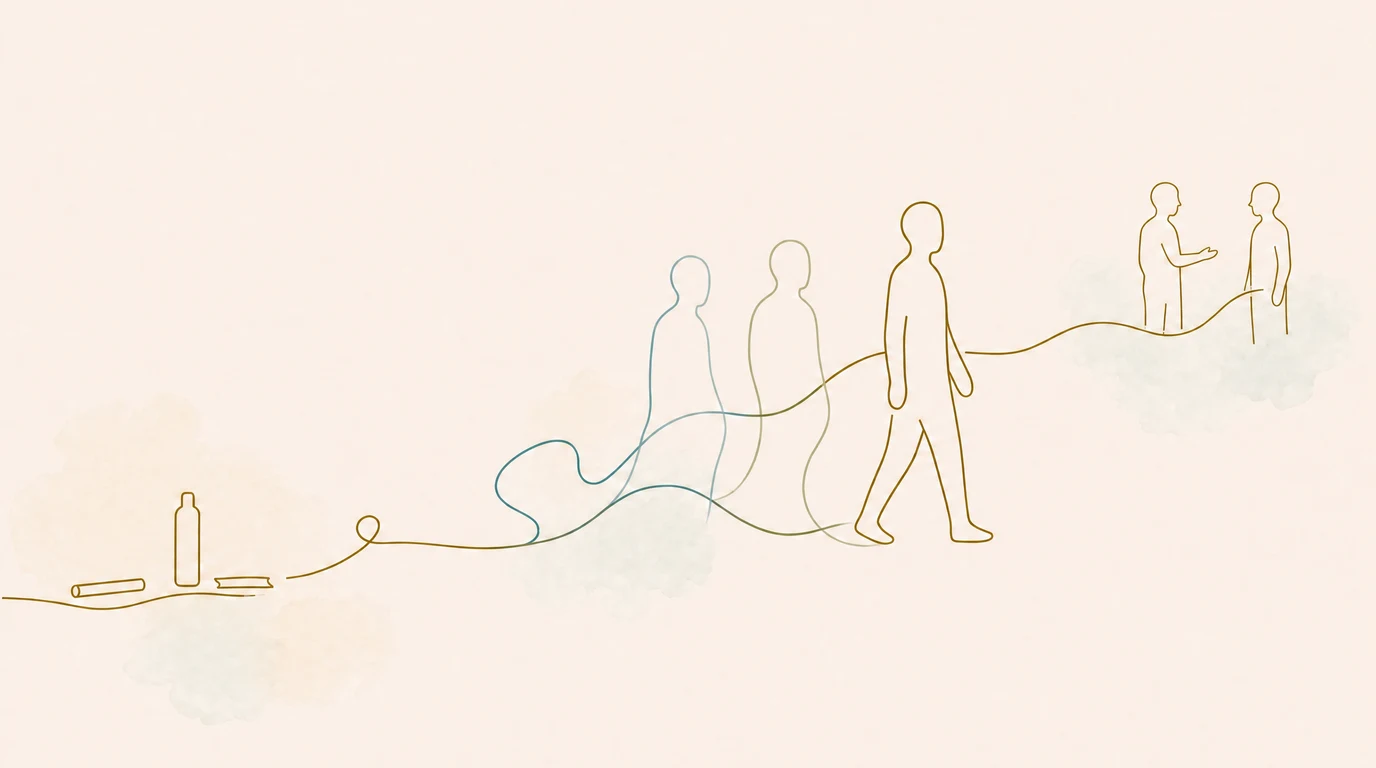
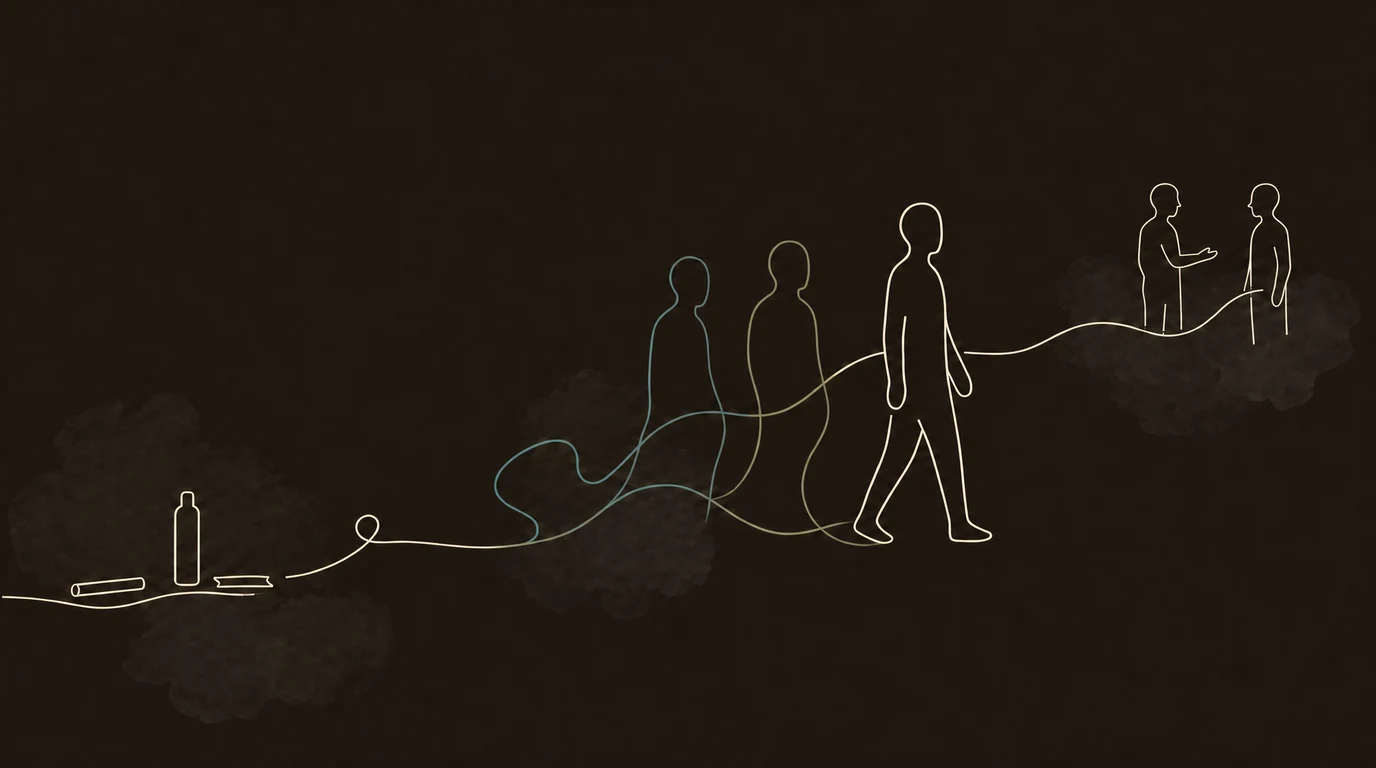
Identity after quitting nicotine can feel less settled than the physical act of stopping. Cigarettes, vapes, pouches, or smokeless tobacco may have been woven into your breaks, friendships, self-image, work rhythm, or sense of independence. Once use ends, the old description of yourself may linger while daily life is already changing.
This transition has received far more research attention in people who smoke cigarettes than in people who use vapes, nicotine pouches, or other products. The smoking evidence still offers useful questions about labels, routines, social belonging, and the gradual move toward a life where nicotine occupies less mental space.
Key takeaways
- Identity after quitting can involve your self-label, routines, social roles, and deeper feelings about nicotine
- A new label may arrive quickly while familiar emotions or rituals take longer to change
- Preserve the useful parts of an old nicotine routine, such as rest, connection, or transition, in a nicotine-free form
- Let repeated ordinary actions provide evidence for the person you already are becoming
- Build several sources of identity beyond recovery so nicotine loses its former organizing role
- Most direct identity research concerns cigarette smoking, with thinner evidence for vaping and nicotine pouches
What identity after quitting nicotine can include
Identity is broader than a label. It can include the categories you use for yourself, the groups you feel part of, the roles you perform, and the story you tell about your own behavior. Nicotine can enter each of these areas.
Someone may think of themselves as a smoker, a vaper, a person who nearly always has a pouch in place, or someone who uses nicotine only at work or with friends. The product can also become part of a scene: the person who joins the smoke break, brings the vape on a drive, shares cigarettes at a bar, or reaches for a pouch before a demanding task.
A meta-ethnography of 17 qualitative studies found that smoker identity among young adults was multifaceted, changed over time, and depended partly on social context. People could express different parts of that identity in different settings. This helps explain why quitting may feel straightforward in one part of life and unfamiliar in another.
Use four areas to describe your own transition:
- Label: the words you currently use for yourself
- Routine: the repeated moments where nicotine had a place
- Social role: how nicotine affected belonging, conversation, privacy, or shared time
- Self-concept: the qualities and personal story you connected with use, quitting, or recovery
These areas can change on separate timelines. A person may say "I stopped smoking" within days and still feel attached to the old break routine months later.
A label and a deeper identity can move at different speeds
Research supports a distinction between a simple self-label and the thoughts and feelings underneath it. In an in-depth study of ten people who had remained abstinent from smoking for a year, participants generally called themselves non-smokers while some residual attraction to smoking remained. The authors described a surface label and a deeper level of identity that could still contain mixed feelings (Vangeli and West, 2012).
That small qualitative study was unable to establish one required sequence. Its participants maintained abstinence while some emotional attachment to smoking remained. Your behavior, label, and feelings can become aligned gradually.
Larger observational studies also find relationships between identity and smoking outcomes. In a representative English sample of 574 people who had quit within the previous year, 80.3% identified as non-smokers. A non-smoker identity was associated with continued abstinence at the three-month follow-up, although the association was absent at six months after adjustment and follow-up losses were substantial (Tombor et al., 2015).
Another longitudinal analysis followed 544 former smokers in Australia and the United Kingdom. People who described a clear post-quit position, including ex-smoker, non-smoker, or a smoker who had chosen to stop, had lower observed relapse risk than the small group describing themselves as smokers trying to quit. The study was observational, used self-reported identity, and produced imprecise estimates for that small comparison group (Callaghan et al., 2021). These results support treating identity as one part of recovery while leaving room for personal language and individual timing.
Audit the place nicotine held in your life
Begin with real situations from the period before you quit. Write down three to five recurring nicotine moments, then describe what each moment signaled about you or your place in the day.
For example:
| Earlier nicotine moment | Possible identity or role | Useful part to preserve |
|---|---|---|
| Cigarette with coworkers | Member of the break group | Conversation and distance from work |
| Vape while driving | Person who decompresses alone | A transition between responsibilities |
| Pouch before a difficult task | Person who prepares to focus | A clear start ritual |
| Smoking at a party | Social smoker or familiar participant | Belonging and an easy way to join others |
| Evening use outside | Person who claims private time | Quiet and separation from household demands |
Choose the interpretation that matches your experience. The same cigarette break can mean companionship to one person, privacy to another, and simple repetition to someone else.
The emotional nicotine triggers guide helps when the old routine was closely connected with stress, boredom, loneliness, anger, sadness, or celebration. Keep this identity exercise focused on the role the routine played in your picture of yourself.
Choose language that fits your current position
Several labels may feel available after quitting: non-smoker, former smoker, former vaper, person in nicotine recovery, nicotine-free, or someone who stopped using nicotine. Each phrase emphasizes a different part of the experience.
Try each phrase in a complete sentence about an ordinary situation:
- "I stopped using nicotine, so I am taking my break inside today."
- "I used to smoke, and I still enjoy spending time with that group."
- "I am nicotine-free, and I keep my morning routine simple."
- "I quit vaping, and the device is no longer part of what I carry."
Keep the sentence that feels accurate enough to use. Accuracy matters more than enthusiasm. A phrase can evolve as your experience changes.
A longitudinal study of 1,036 smokers and former smokers found reciprocal relationships among smoker identity, quitter identity, and smoking behavior over time. Identity may shape behavior, and behavior may also shape identity (Meijer et al., 2018). This supports a flexible process in which language and action can influence each other.
Rebuild the familiar roles around nicotine
An old routine often held a role that deserves a new form. Start with one repeated situation from your audit and define its beginning, useful function, and ending.
Suppose a smoke break began after finishing a task, provided movement and conversation, and ended when coworkers returned inside. A nicotine-free version might keep the same time and social contact while changing the location or activity. The role remains "coworker taking a real break" while smoking leaves the sequence.
For a vape used during transitions, create a clear marker at the same boundary: put away work materials, start one chosen playlist, walk around the block, or send a message before beginning the next part of the day. For a pouch used before focused work, prepare the desk, set the first task, and begin with a consistent drink or short breathing pause.
The exact replacements for employment and travel routines belong in the guide to rebuilding work breaks and commutes without nicotine. The identity question here is which role you want to retain: someone who protects a break, moves between tasks deliberately, connects with coworkers, or creates private time.
Let social belonging change deliberately
Smoking identity can be social as well as personal. The meta-ethnography of young-adult smoking found that people used smoking in aspirational identities, group belonging, and context-specific social roles (Tombor et al., 2015). A separate qualitative study of 24 women who quit smoking during pregnancy found that changes in relationships with people who smoked were central to their experience after quitting (Nguyen et al., 2012). Both bodies of evidence concern specific populations and cigarette smoking, so apply the questions to your own setting with care.
List the groups where nicotine had a social function. For each group, decide what you want to keep:
- the people and conversation
- the shared break time
- the feeling of being invited
- a private conversation away from the main group
- a familiar identity such as musician, coworker, gamer, hospitality worker, or friend
Then choose one way to stay connected without relying on product use. You might join part of the break, invite one person for coffee, keep attending an event with a planned departure time, or create contact in a setting where nicotine has less visibility.
Some relationships may shift because the shared activity carried most of the connection. That discovery can be painful and useful. Direct your effort toward people and contexts where the relationship has room to continue.
Build evidence through ordinary actions
Identity statements become more believable when they describe repeated behavior. Choose a small set of actions that already fit the life you want to recognize.
Examples include:
- leaving home without checking a nicotine supply
- taking a full break and returning at the planned time
- carrying what you need for the day without a device, pack, or tin
- spending time with a friend in a nicotine-free setting
- starting a difficult task through a prepared routine
- keeping one promise unrelated to recovery
- practicing a role you value, such as parent, partner, friend, teammate, student, artist, or neighbor
Record the action as a fact: "I took my afternoon break and walked with a coworker." A factual record gives the new self-description something concrete to rest on.
Identity-focused research remains mostly observational. Causal evidence that repeating a particular sentence produces abstinence is missing. The practical value of these records is simpler. They help you notice the life that already exists outside nicotine.
Make your identity wider than recovery
Recovery may need concentrated attention early on. Over time, a self-concept organized entirely around quitting can keep nicotine at the center of your day. Add roles, interests, relationships, and responsibilities that would still matter if recovery required little thought.
Choose three areas that already belong to you or deserve more room:
- A role you contribute through: friend, parent, colleague, volunteer, student, caregiver, neighbor, or team member
- An activity you practice: cooking, lifting, music, reading, hiking, gaming, gardening, making, learning, or a craft
- A quality you demonstrate through action: dependable, curious, patient, direct, generous, prepared, or attentive
Write one current example beside each area. Keep the examples modest and true. "I called my brother back" supports the description "dependable" more effectively than an idealized description of the person you hope to become.
If you want to clarify the values behind this direction, the guide to personal reasons for quitting nicotine has a separate exercise for autonomy, time, money, health, relationships, and other priorities. Identity work uses those values in daily roles and behavior.
When the old identity still feels present
An old identity can become noticeable in a familiar place, around people who use nicotine, or during a life transition. The feeling may appear as nostalgia, a sense of exclusion, or the impression that the nicotine-free version of the situation still feels new.
Name the exact part that returned. "I miss talking outside after dinner" gives you a social routine to address. "I miss the person I was at those shows" points toward memory, belonging, and a period of life. "I still picture myself with a vape when I drive" identifies a scene that needs more nicotine-free repetition.
Research on vaping identity is developing. A 2024 prospective study of people using electronic cigarettes to quit smoking found that changes in smoker, vaper, non-smoker, and dual-user identities were associated with later smoking outcomes. Its population used vaping as cigarette-cessation support, leaving identity change after quitting exclusive vaping unresolved (Frings et al., 2024). Direct identity evidence for nicotine pouches remains especially limited.
Treat broad conclusions cautiously. Your personal observations can still inform your routines, language, and social choices even where product-specific research is sparse.
Review the transition without grading it
Revisit your identity audit after several ordinary weeks. Look for changes in four areas:
- Language: which description now feels natural and accurate?
- Routines: which nicotine-free sequences happen with less planning?
- Belonging: where has connection continued or changed?
- Breadth: which roles and interests now receive more time or attention?
The broader nicotine recovery timeline tracks physical, behavioral, and motivational change after the first week. Identity may move alongside those areas at its own pace.
Keep any evidence of change that you can state plainly. A new routine, a social situation handled in a different way, or an ordinary day with little thought about nicotine all describe the transition more accurately than a demand to feel completely transformed.