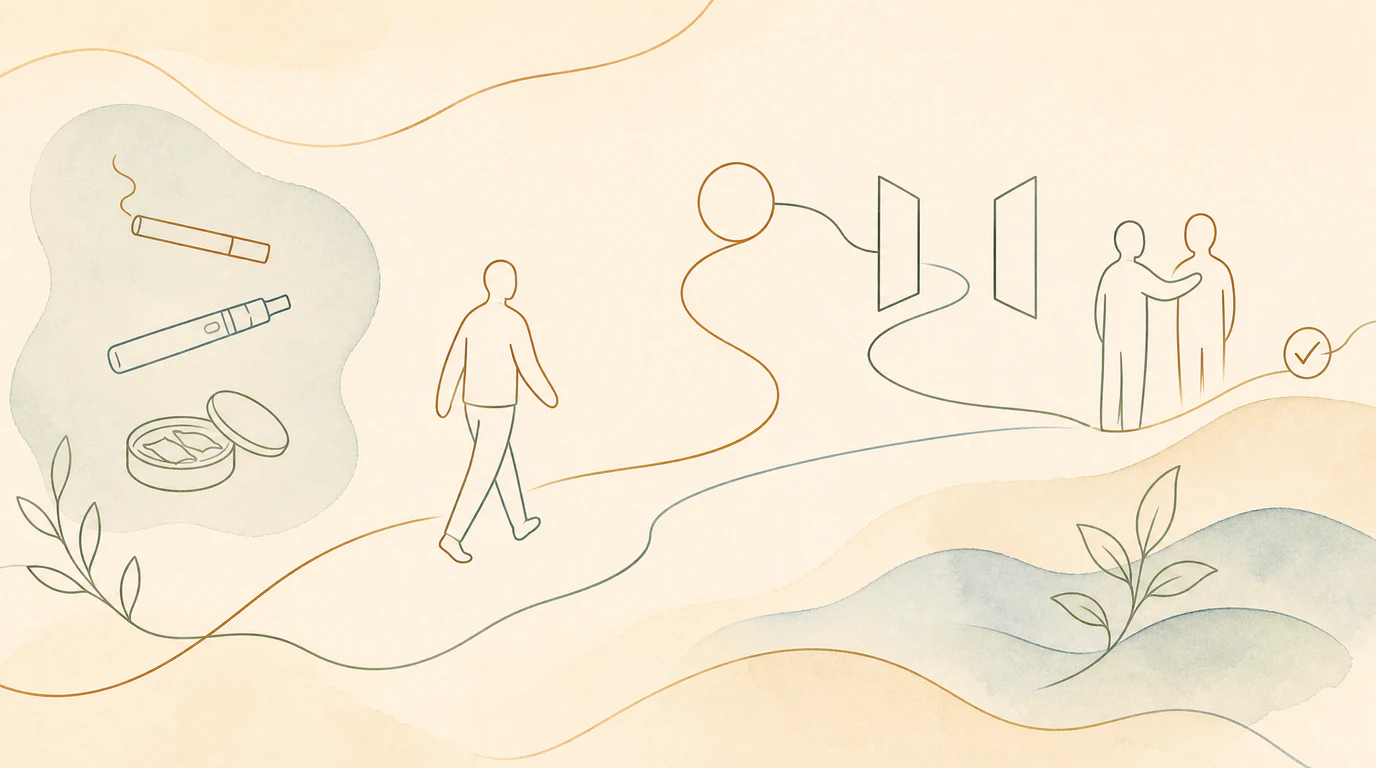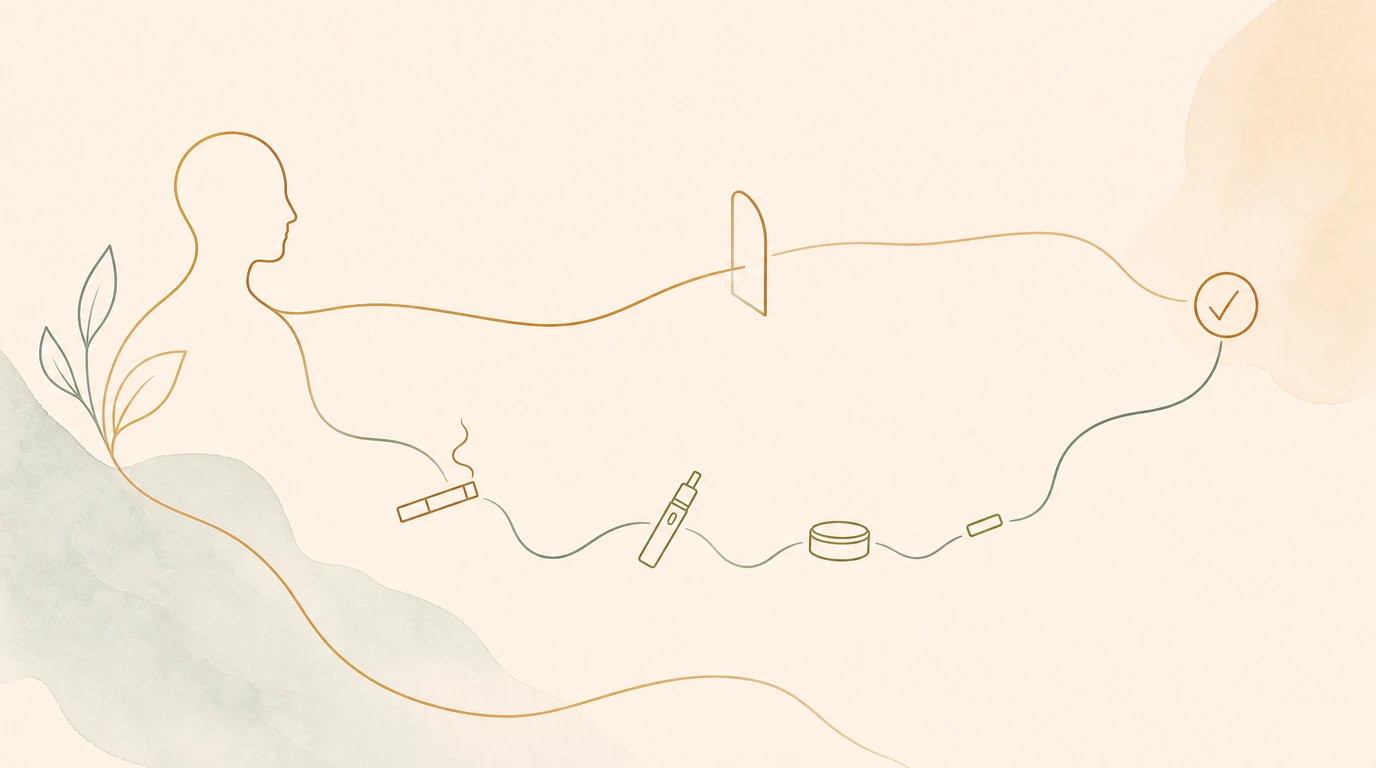
Quitting nicotine as a teenager can mean handling withdrawal while still going to class, seeing friends who use nicotine, sharing space with family, and depending on adults for some healthcare. A useful plan has to work inside that reality.
You can build the plan around your school day, choose carefully who knows, ask direct questions about confidentiality, and use support designed for your age. The goal is a setup you can follow through classes, lunch, practice, work, and home.
Key takeaways
- Map the exact parts of school where nicotine usually appears, then prepare one change for each point.
- Keep peer responses short and pair them with a physical exit or a supportive person.
- Choose support selectively. One safe adult or confidential service can be enough to begin.
- Ask how privacy works before sharing details with a clinic, school service, app, text program, or quitline.
- Get age-appropriate clinical advice for medication or quit aids.
- Immediate safety concerns, including nicotine-liquid exposure or feeling unable to stay safe, need urgent local help.
Start with a plan that fits your age and product
Write down every nicotine product you use, including cigarettes, vapes, pouches, and smokeless tobacco. Include products you borrow, share, or use only with friends. Estimate when you use each one and how easily you can reach it during an ordinary weekday.
Then choose a clear starting point. The broader decisions about a quit date, preparation, access, and support belong in the guide to quitting nicotine. This article adds the teenager-specific parts of that plan.
Begin with four details:
- Your target: the nicotine products covered by your quit attempt.
- Your start: the date or planned reduction schedule you chose.
- Your school risks: the times, places, and people most connected with use.
- Your support route: the person or service you can contact when the plan gets hard.
Youth cessation evidence is still developing. A 2025 American Thoracic Society guideline recommends counseling for adolescents who use nicotine and also supports technology-based interventions, while rating much of the evidence as low or very low certainty (Bauer et al., 2025). That makes a flexible plan important. You can use the parts that fit your product, age, access, and daily life, then adjust them from experience.
Build a school-day map
School can connect nicotine with specific places and transitions. A qualitative study of 62 adolescents found that social influence at school, easy product access, stress, and negative mood were important barriers during vaping quit attempts (Kong et al., 2021). Your own map can show where those pressures enter your day.
Walk through a normal weekday in order:
- Before school: waking, getting ready, the trip in, and waiting outside.
- During classes: long lessons, concentration dips, tests, and bathroom breaks.
- Between classes: particular hallways, bathrooms, exits, or groups of friends.
- Lunch: where you sit, where friends go, and how much unstructured time you have.
- After school: the trip home, practice, clubs, a job, homework, and time alone.
- At home: where products are stored, who else uses them, and when privacy or stress changes.
Mark the two or three points where nicotine feels easiest to reach or hardest to refuse. Give each point one practical change. You might take a different hallway, use a bathroom away from the usual group, eat lunch with a supportive friend, go directly to practice, keep your hands occupied on the bus, or message someone after the final bell.
Choose changes that fit school rules and keep you safe. If you need to dispose of a device or another product while at school, ask a nurse, counselor, administrator, or trusted adult how to handle it under local policy. Carrying it through the day can keep access open and may create disciplinary problems.
Your school map covers the setting. The first day without nicotine guide can help you plan the rest of that first day, including meals, breaks, evening, and sleep.
Prepare for offers and peer pressure
Friends may offer nicotine automatically because sharing has been part of the routine. Some may tease you, question your decision, or keep using beside you. A short prepared response reduces the amount you have to decide in the moment.
Try a line that sounds natural in your voice:
- "I am off nicotine."
- "Please stop offering it to me."
- "I am quitting. Keep that away from me."
- "I am heading back inside."
The next action matters as much as the sentence. Move to another group, sit in a different place, call or message a supportive friend, or leave the area. Repeating the same line can end an argument faster than explaining every reason behind your decision.
Decide which friendships can support your recovery. One friend may agree to avoid offering products, walk a different route with you, or check in after lunch. Another group may remain closely tied to nicotine use. You can reduce time in the highest-risk setting while keeping contact in places where nicotine is less central.
Social plans can change as your confidence grows. You are making room for recovery during a demanding period, and the arrangement can be reviewed later.
Choose one safe source of support
A large disclosure is unnecessary. Start with one person or service that feels safe and useful. Options can include a parent or guardian, another relative, family doctor, pediatric clinician, pharmacist, school nurse, counselor, coach, teacher, youth worker, or quit-support service.
Think about what you need from that person:
- help making an appointment
- a ride or permission to attend
- a private place to talk
- support during lunch or after school
- help removing nicotine products from home
- calm contact during a difficult evening
- help understanding a school policy or treatment option
Give them a specific request. "Can you check in with me after school this week?" is easier to act on than a general request for help. The guide to asking for support while quitting nicotine has more examples for that conversation.
Family involvement can be valuable when home is safe and the adult responds supportively. Some teenagers face punishment, conflict, rejection, or another safety risk around disclosure. In that situation, begin with a clinician, youth service, or another trusted adult and explain the concern. You can ask for help deciding whether, when, and how to involve family.
Ask how confidentiality works before you share
Privacy rules vary by country, state or province, age, service, school, and the type of care. Health information can also appear through appointment reminders, patient portals, pharmacy messages, or insurance records. School health records may follow different rules from clinic records.
The American Academy of Pediatrics describes confidentiality as an important part of adolescent care while recognizing legal reporting duties and immediate safety exceptions (American Academy of Pediatrics, 2024). A provider should be able to explain the boundaries that apply in your situation.
Ask these questions before giving the full story:
- What can stay confidential at my age?
- What would make you contact a parent, guardian, school, or another person?
- Where will this conversation be recorded?
- Who can see the patient portal, school record, appointment reminder, prescription, or insurance claim?
- Can I speak with the clinician alone for part of the visit?
- How can you help me share information safely if another adult needs to know?
Ask the same questions of a school nurse, counselor, text program, app, chat service, or quitline. Look for a privacy policy and age requirements. Review notification previews on a shared device before using a digital service for sensitive support.
Confidentiality has limits when someone faces immediate danger, abuse, or another legally reportable safety concern. A trustworthy professional can explain those limits early and include you in the next steps whenever possible.
Use help designed for teenagers
Youth-focused support may fit school schedules, peer pressure, family involvement, and age-based access more closely than a general adult program. It can come through counseling, a clinician, a school or community service, a quitline, moderated chat, or a text program.
In a randomized trial of 1,503 US adolescents aged 13 to 17, a tailored interactive text program produced higher self-reported 30-day vaping abstinence at seven months than assessment-only messages, 37.8% compared with 28.0% (Graham et al., 2024). The result applies to that program and study population, and it shows that private, youth-specific digital support can be useful for some teenagers.
When you compare services, check:
- the ages they accept
- the nicotine products they cover
- whether a parent or guardian must consent
- how messages, records, and billing are handled
- whether the service is free or has a cost
- which languages and accessibility options are available
- what happens if you need clinical or urgent support
In the United States, the CDC lists current youth resources such as Smokefree Teen, text support, and quitline services (CDC, 2024). Other countries and regions use different services. A clinician, pharmacist, public health department, or youth health organization can point you toward local options.
Medication and nicotine quit aids require age-appropriate advice. Recommendations and access can change by age, product, medical history, and location. Use only medication supplied or recommended for you, and ask a clinician or pharmacist how to use it. Bring an honest list of your nicotine products and frequency so the advice matches your actual exposure.
Know when to seek urgent help
Most nicotine withdrawal is uncomfortable and temporary. The full symptom pattern and usual timing are covered in the nicotine withdrawal symptoms guide.
Some situations need direct help:
- Liquid nicotine was swallowed or got into the eyes, or there is a concerning skin exposure.
- You have severe vomiting, confusion, fainting, a seizure, serious breathing trouble, chest pain, or another possible medical emergency.
- Anxiety, depression, panic, or agitation becomes severe or keeps getting worse.
- You are thinking about harming yourself or feel unable to stay safe.
- Disclosure at home could put you in danger.
Contact a local poison service or emergency service for possible nicotine poisoning. The US Food and Drug Administration advises immediate poison-control contact when e-liquid is swallowed and prompt washing after skin exposure (FDA, 2024). Use the equivalent service where you live.
For an emotional or physical safety crisis, contact local emergency or crisis support and move toward a safe adult or staffed place. If home feels unsafe, tell the professional that clearly so the response can account for your safety.
Keep the plan small enough to use
Your first version can fit in a private note:
- I am quitting: the products included in your plan.
- My start: the date or reduction schedule.
- My hardest school points: two or three times and places.
- My change at each point: a route, place, activity, or person.
- My peer response: one short sentence.
- My support: one person or service and how to reach them.
- My privacy questions: the details you want answered before sharing.
- My urgent route: local poison, crisis, or emergency support.
Review the note after a few school days. Keep the parts that helped and revise the points that stayed difficult. A teenager-specific plan becomes useful through those real adjustments, one class, lunch period, trip home, and evening at a time.