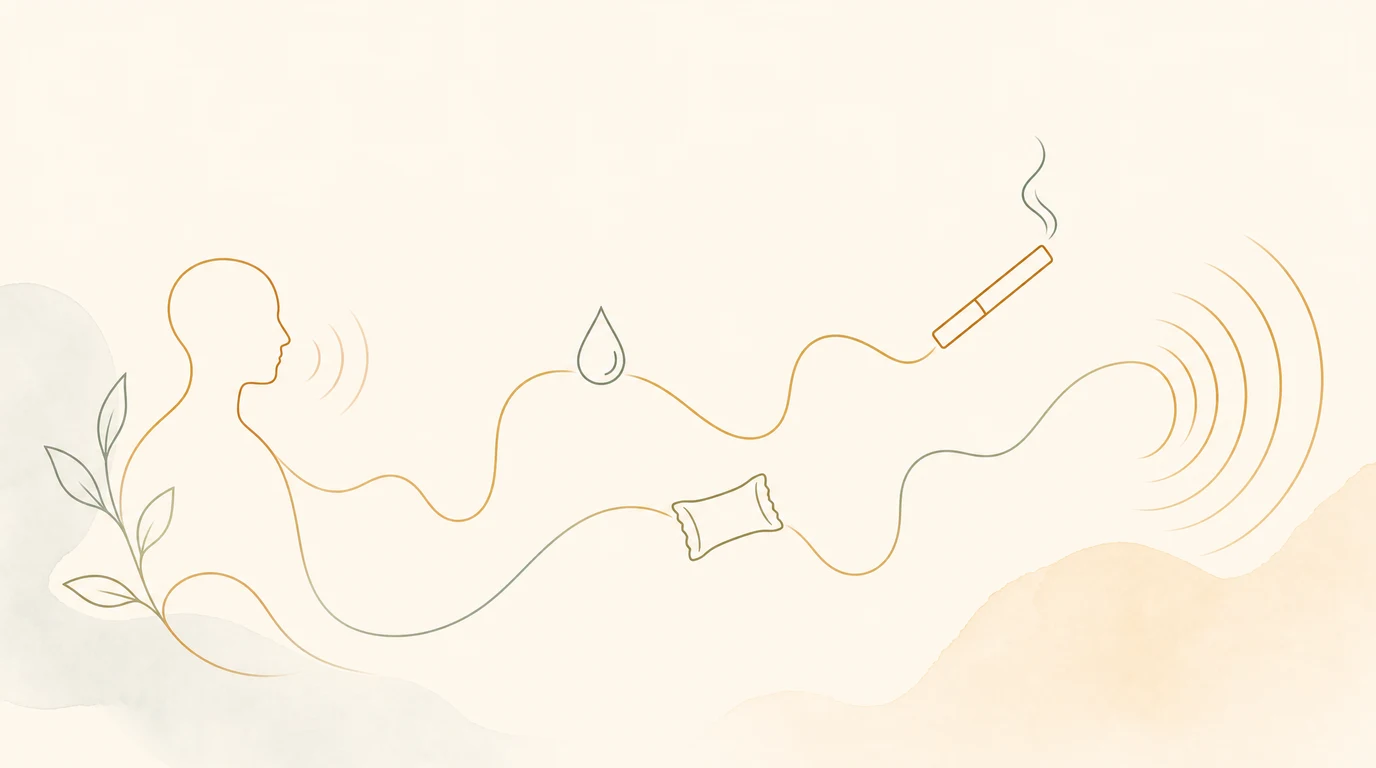
Why nicotine is hard to quit becomes clearer when dependence is viewed as several connected processes. Regular exposure changes how the body and brain respond to nicotine. Falling nicotine levels can bring discomfort, another dose can relieve part of that discomfort, and repeated use links nicotine with places, feelings, movements, and daily routines.
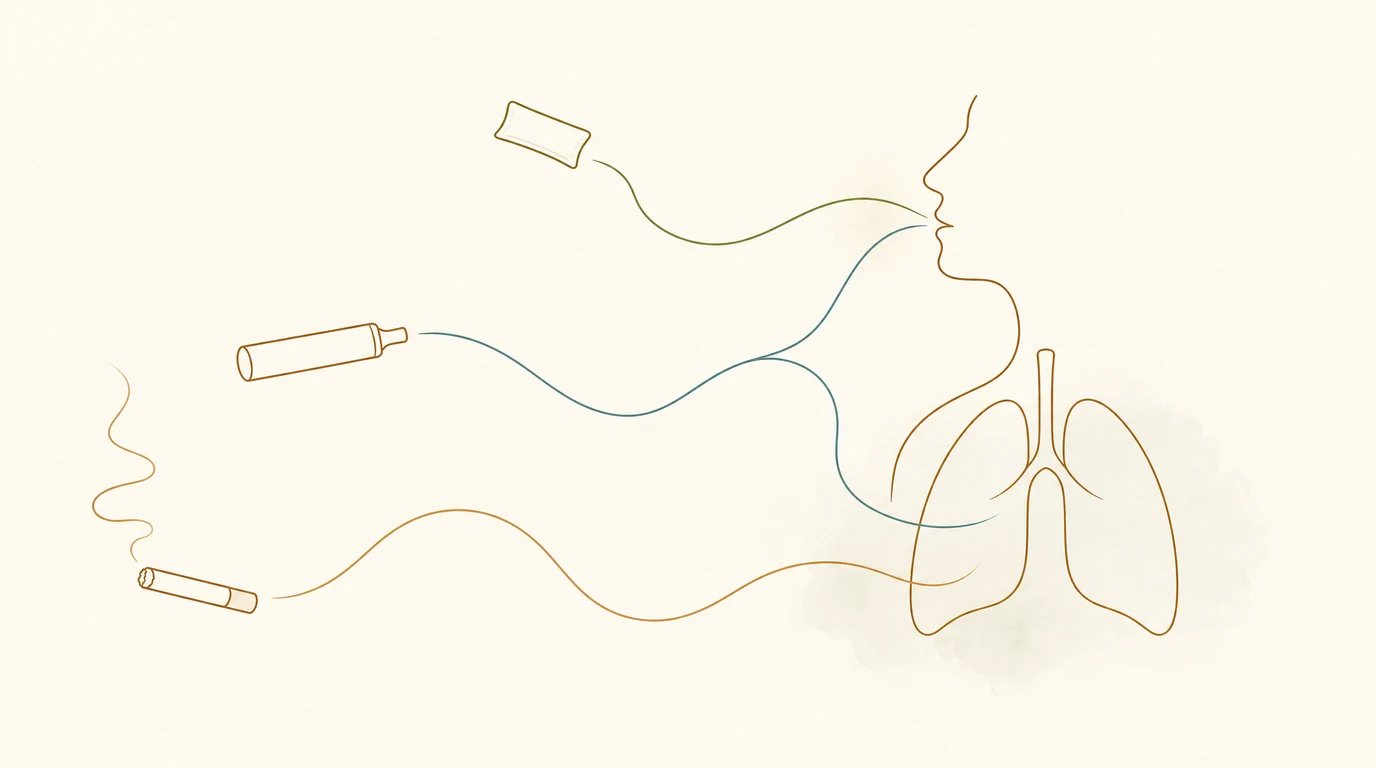
The balance differs between people. One person may notice strong withdrawal between doses. Another may use mainly in a few highly familiar situations. Cigarettes, vapes, pouches, and oral tobacco also deliver nicotine at different speeds and support different patterns of repetition and access.
This guide explains the combined physical, learned, and emotional model. The signs of nicotine addiction self-assessment covers individual patterns of control and impact. The nicotine quit-plan guide turns a decision to quit into concrete steps.
Key takeaways
- Repeated nicotine exposure can produce neuroadaptations that support physical dependence
- Falling nicotine levels may cause discomfort, and another dose can quickly reinforce relief
- Delivery speed, dose timing, repetition, and easy access shape how often the loop is practiced
- Places, feelings, people, objects, and routines can become learned nicotine cues
- Acute withdrawal and learned associations follow different courses, so difficulty may continue in a different form
Why nicotine is hard to quit: the combined model
Nicotine dependence involves pharmacology, learning, behavior, and environment. A major clinical review describes nicotine addiction as an interaction among the drug's effects, conditioned factors, genetics, social influences, and product design (Benowitz, 2010). Each part can increase the likelihood of another use.
Four processes often overlap:
- Physical dependence: repeated exposure changes nicotinic receptor systems and the response to falling nicotine levels.
- Withdrawal relief: another dose may reduce discomfort that appeared as nicotine levels declined.
- Learned associations: contexts and sensations repeatedly paired with nicotine begin to predict it.
- Automatic routines: frequent sequences require less conscious deliberation as they become familiar.
Emotional learning can run through all four. Nicotine may be used during stress, boredom, frustration, social discomfort, or sustained concentration. Relief or stimulation then becomes attached to the situation. The next appearance of that feeling can prompt an expectation of nicotine before a deliberate choice has fully formed.
Physical dependence changes the response to a pause
Nicotine activates nicotinic acetylcholine receptors throughout the brain and body. Repeated exposure produces adaptations in receptor function and in several neural systems involved in reward, aversion, learning, and withdrawal. When nicotine levels fall, those adapted systems continue operating after the expected exposure ends (Benowitz, 2010).
This helps explain why a pause can feel different after regular use. The change may be noticed as a desire for nicotine, difficulty settling into a task, irritability, restlessness, or a general sense that something is missing. The full symptom list and usual course belong in the nicotine withdrawal guide.
Dopamine participates in nicotine reinforcement and drug seeking. Current neuroscience also identifies important roles for glutamate, GABA, nicotinic receptor subtypes, and circuits involved in reward, aversion, and withdrawal (Kim and Picciotto, 2023). The biology therefore extends across multiple signaling systems and behavioral processes. Simple claims about a dopamine reset leave out most of this model.
Withdrawal relief can reinforce another dose
Nicotine use can feel calming, focusing, or stabilizing. Some short-term effects occur directly. With regular use, part of the apparent improvement may come from reversing discomfort that emerged between doses. Researchers call this negative reinforcement: an action becomes more likely because it removes or reduces an unpleasant state.
A review of nicotine addiction describes a daily cycle in many people who smoke. Nicotine levels rise with use, tolerance develops during the day, levels fall, and later smoking relieves withdrawal symptoms (Prochaska and Benowitz, 2019). This cycle can make the next dose feel as if it restored ordinary calm or concentration.
Emotional experience varies. In a study of treatment-seeking adults who smoked, greater dependence was associated with higher negative affect and craving before and after a quit attempt. Negative affect and craving were also linked across several forms of measurement (Robinson et al., 2011). These findings concern cigarette smoking, and they support a measured explanation of how discomfort and nicotine seeking can reinforce each other.
Brief withdrawal changes can provide many learning trials during the day, including periods of mild discomfort. The sequence becomes dependable: discomfort appears, nicotine follows, and the discomfort changes. Repetition strengthens the expectation that nicotine is the available response.
Delivery speed and repetition shape reinforcement
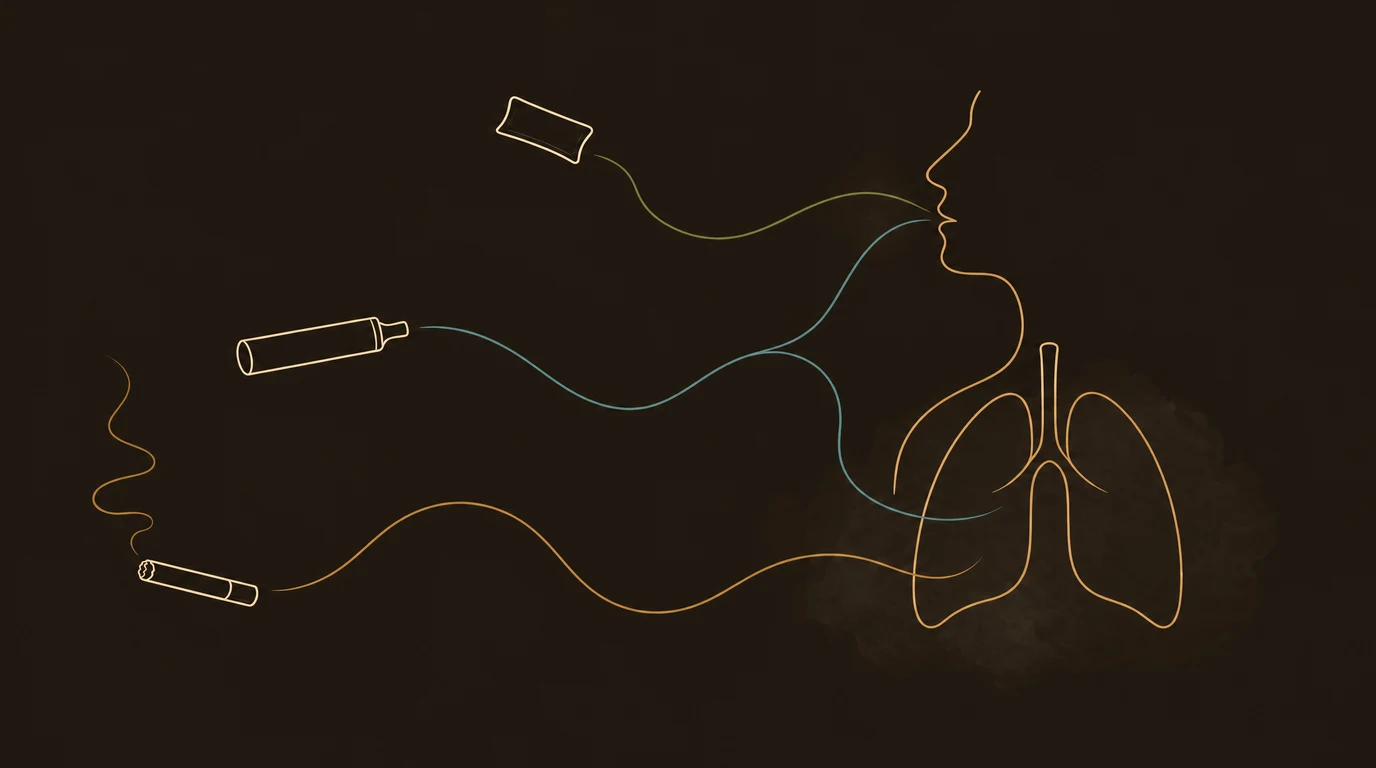
The way nicotine reaches the body affects the experience. Inhaled nicotine can reach the brain quickly, which places the pharmacologic effect close in time to the action that produced it. A clinical pharmacology review explains that rapid delivery, high arterial concentrations, and puff-by-puff dose adjustment contribute to the abuse liability of inhaled nicotine systems (Benowitz et al., 2021).
Other products follow different absorption curves. The important variables for dependence include how quickly the effect arrives, how much nicotine is delivered, how long exposure continues, how often use repeats, and how easily another dose can be taken. A portable product can also travel across many settings, allowing the same response to be rehearsed during work, driving, meals, entertainment, and social time.
Frequency matters because learning receives another trial with every use. A cigarette creates a series of puffs within one episode. A vape can be used in short, loosely separated episodes. A pouch can remain in place during other activities. These product patterns create different boundaries around use. Each can support repeated nicotine exposure and cue learning.
Product toxicants, health risks, and cigarette-equivalent dose comparisons require their own evidence and measurements. In this explanation, delivery describes how closely the drug effect is connected to the repeated behavior.
Cues can begin predicting nicotine
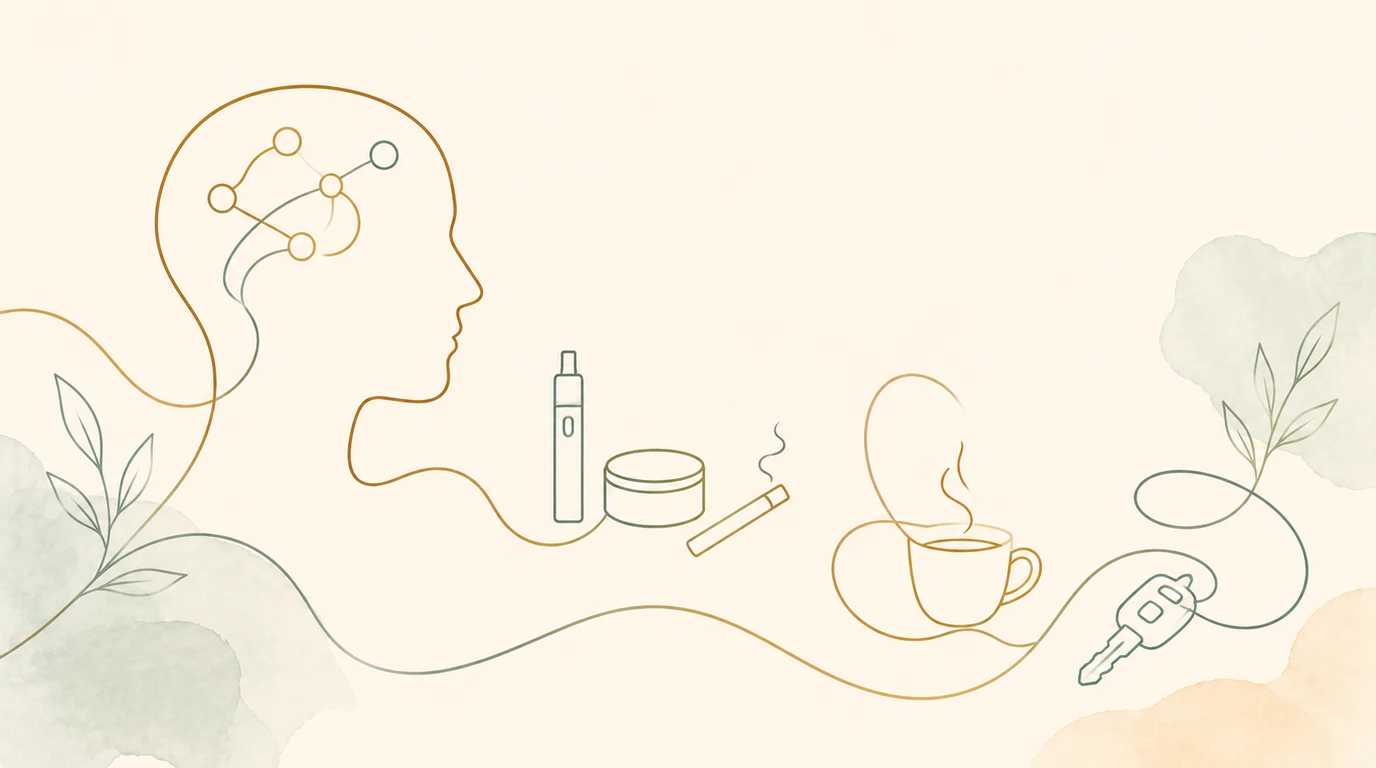
Nicotine use rarely occurs in an empty context. It happens after waking, with coffee, during a break, in a car, after a meal, at work, during a conversation, or when a particular feeling appears. Repeated pairing allows those details to predict nicotine.
A meta-analysis of 128 publications found a moderate-to-large increase in self-reported craving when people who smoked encountered smoking cues compared with neutral cues. The size of the response varied with cue type, personalization, setting, and measurement method (Betts et al., 2021). Most direct cue-reactivity evidence comes from cigarette studies, so extensions to every nicotine product need care.
Learning can include sensory details, actions, and whole settings. A review of nicotine and learning describes drug-context and drug-cue associations that can prompt nicotine seeking during abstinence (Gould et al., 2014). For vaping, the cue might include holding a device, a flavor, or seeing it on a desk. For pouches, it might include opening a can, oral sensation, or beginning a focused task.
The nicotine cravings and triggers guide covers how to separate withdrawal-driven cravings from sensory, routine, emotional, social, and access cues. This explanation stays with the learning process that gives those cues influence.
Repeated routines can become automatic
Many nicotine episodes begin as a familiar sequence. A person finishes a meal, stands up, reaches for the product, and moves to a usual location. Another unlocks a phone, starts work, and uses nicotine before noticing a conscious decision. Familiarity reduces the attention required to start the sequence.
Automaticity describes how a well-practiced response can begin quickly when its usual context appears. A person may notice and change the response after it begins. Nicotine adds pharmacologic reinforcement to the repetition. Relief and sensory effects give the sequence an immediate consequence.
The same product may become attached to many small routines. This expands the number of daily entry points into the pattern. Removing one episode can leave the others intact because each has its own time, place, action, and expected effect.
Emotions can become part of the learned pattern
Stress, boredom, frustration, loneliness, excitement, and social comfort can all become internal cues. When nicotine repeatedly follows one emotional state, the state begins to predict the product. A new event can produce the feeling and activate the learned expectation.
Withdrawal relief can make this association especially persuasive. Irritability or tension develops as nicotine levels fall, nicotine use changes the feeling, and the person learns that nicotine helps with irritability or tension in general. Benowitz describes this conditioning process as one way unpleasant moods become cues for smoking (Benowitz, 2010).
People can also value direct stimulation, concentration, a pause from demands, a reason to step outside, or connection with other users. Those functions belong in the model because the nicotine episode may include both a drug effect and a change in the surrounding situation.
This section explains how emotional reinforcement develops. Persistent anxiety, depression or low mood, trauma-related distress, and other mental-health concerns deserve their own assessment and support. Acute mood symptoms during withdrawal also have a separate course.
The balance differs between people and products
The strength of each dependence mechanism varies between people. Metabolism, genetics, age of exposure, frequency, dose, delivery, access, co-occurring stress, and the number of learned contexts can all influence the pattern. These interacting contributors can produce different balances of physical dependence, withdrawal relief, cue learning, and routine.
This variation produces many combinations. A person with obvious withdrawal may also have strong situational cues. Another person may have mild discomfort and strong associations with a small number of repeated settings. Someone who switches products may carry old routines forward and learn new ones.
Counts capture frequency across cigarettes, puffs, pouches, and oral tobacco. The broader pattern includes the timing of nicotine, the situations attached to it, the speed of its effects, and what the episode changes for the person.
Learned associations can outlast acute withdrawal
Nicotine levels fall after use stops, and acute withdrawal usually eases with time. Learned associations follow a separate course. A familiar cue can still activate the expectation of nicotine after the early physical adjustment has settled.
A later desire can reflect a setting retrieving a well-practiced prediction after active nicotine exposure has fallen. Research on nicotine and learning connects drug-context associations with nicotine seeking during abstinence and relapse vulnerability (Gould et al., 2014).
Physical dependence and cue learning also interact. Withdrawal can strengthen attention to nicotine cues during early abstinence. Familiar cues can make discomfort feel more urgent. As the physical component changes, the relative influence of routines, access, and emotion may become easier to see.
What the combined model means for quitting
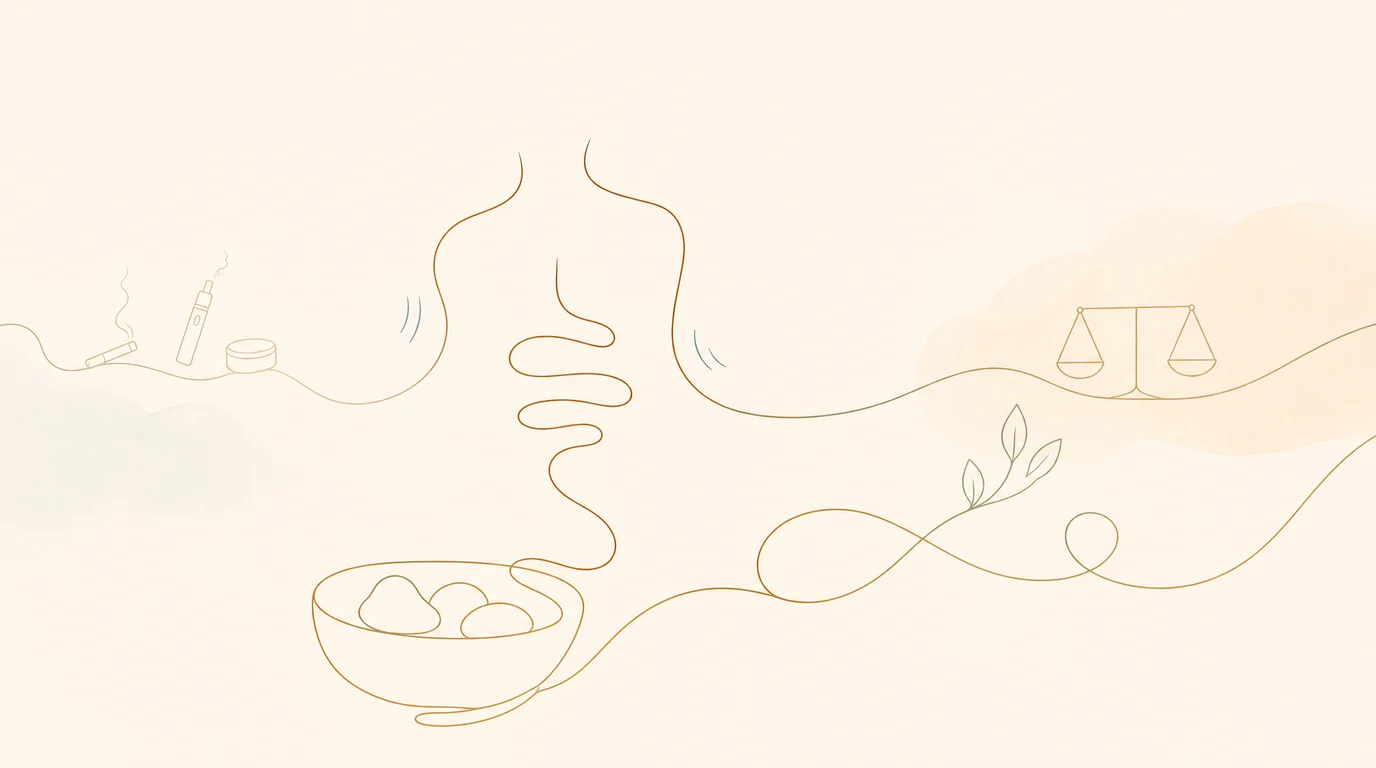
Difficulty quitting nicotine is understandable when several processes are active together. A plan may need to account for current exposure, the expected withdrawal period, product access, cue-linked routines, emotional situations, and support. Each area addresses a different part of the pattern.
The model also explains why several targeted changes may be useful. Removing a device reduces access. Withdrawal follows its own course. Getting through withdrawal changes the physical pressure. A coffee routine can retain its learned association. Understanding a trigger clarifies the pattern. An automatic action may need a prepared interruption.
Use the nicotine withdrawal symptom guide for the physical timeline and the cravings and triggers guide for learned cues. The complete nicotine quit plan brings those parts into one practical structure.
Nicotine dependence can feel different across days because the balance among physical discomfort, available products, emotions, and cues keeps changing. Seeing those parts separately gives a clearer explanation of the difficulty and shows which part is active at a particular moment.