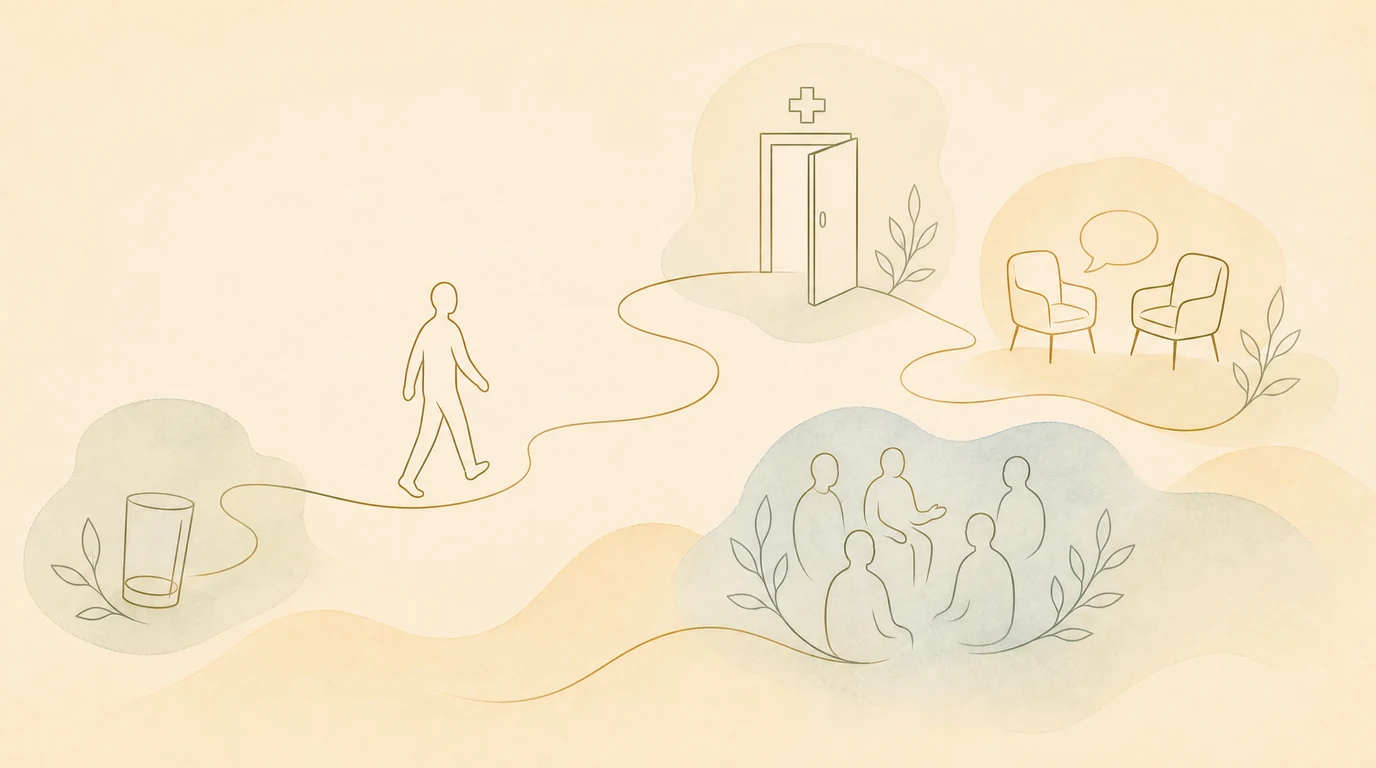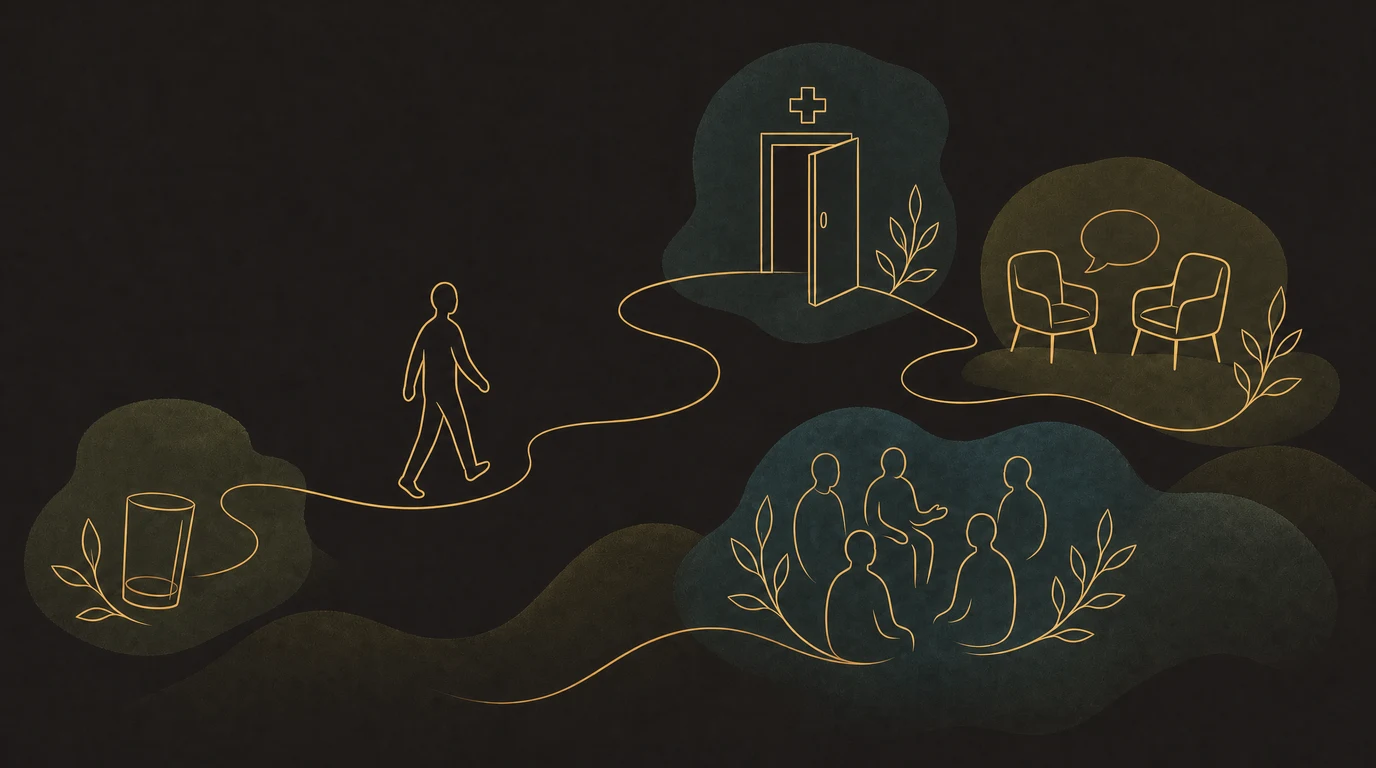

Therapy for alcohol use disorder turns a broad wish to change into a structured process. Sessions can examine what keeps drinking going, practice responses to predictable situations, and review what happened when those responses were tested in daily life.
Therapy is a broad category. Cognitive behavioral therapy, motivational interviewing, motivational enhancement therapy, contingency management, and behavioral couples therapy use different methods. A clinician may combine elements while still explaining what the work is meant to change.
Therapy does not replace medical assessment for possible alcohol withdrawal. If stopping alcohol may be medically risky, review the alcohol safety guide and seek clinical guidance.
Key takeaways
- Early sessions should clarify your drinking pattern, goals, safety, and reasons for change
- CBT focuses on learned patterns and practical responses to high-risk situations
- Motivational approaches help resolve ambivalence and strengthen chosen reasons for change
- Couples or family involvement can help when relationship patterns affect drinking and recovery
- Progress should be reviewed with concrete outcomes, and the plan can change when it stalls
What happens in the first sessions
The therapist usually begins by understanding:
- your current drinking pattern and consequences
- what you want to change
- previous attempts and treatment
- withdrawal or other immediate safety concerns
- physical and mental-health conditions
- other substance use and current medicines
- work, relationships, housing, culture, identity, and support
- practical barriers such as cost, time, privacy, transport, or childcare
The assessment should lead to a working formulation, which is a plain explanation of the patterns treatment will address. It might connect drinking with stress after work, social anxiety, conflict, sleep, access at home, or beliefs about what alcohol provides.
You should also discuss confidentiality and its legal limits, session frequency, cancellation rules, contact between sessions, crisis procedures, fees, and coordination with medical care.
Cognitive behavioral therapy
Cognitive behavioral therapy (CBT) examines connections among situations, thoughts, emotions, actions, and consequences. Alcohol-focused CBT often includes:
- monitoring drinking and high-risk situations
- identifying the first decision in a drinking sequence
- testing beliefs about alcohol's effects
- planning responses to cravings and offers
- changing routines and access
- practicing problem solving and communication
- reviewing a slip without abandoning the wider plan
A 2023 systematic review found CBT to be an empirically supported treatment across substance-use disorders, while noting variation in formats, populations, and comparison conditions (Boness et al., 2023).
CBT should involve more than discussing the previous week. Ask what skill you are practicing and how it will be tested before the next session.
Motivational interviewing and enhancement therapy
Motivational interviewing (MI) uses a collaborative conversation to explore ambivalence and strengthen the person's own reasons for change. The clinician listens for competing priorities, reflects them accurately, and helps the person decide what action fits their values.
Motivational enhancement therapy adapts this style into a structured course that may include assessment feedback and a change plan. These approaches can be useful when part of you wants change and another part expects alcohol to remain valuable.
A 2023 meta-review of 23 meta-analyses found small benefits for motivational interviewing, for involving a significant other, and for combining CBT with MI in alcohol use disorder. The authors rated the broader evidence base as low to moderate quality (Dellazizzo et al., 2023).
MI should support an honest decision process. It should not feel like a disguised lecture in which only one answer is allowed.
Combining motivational work with CBT
Motivation and skills often need to develop together. A person may have strong reasons to change and still lack a response for Friday night. Another person may know many coping skills while remaining unsure whether they want to use them.
A network meta-analysis of 19 trials involving 7,149 adults found that multiple face-to-face sessions combining MI and CBT ranked highest for reducing AUDIT scores. Certainty was low for most comparisons, so the ranking should be interpreted cautiously (Tan et al., 2023).
In practice, combined work might use one session to clarify the reason for change, another to map a recurrent sequence, and later sessions to review the plan under real conditions.
Contingency management
Contingency management connects a defined behavior or verified outcome with a consistent reward. In alcohol treatment, programs may reinforce attendance, completion of activities, or alcohol-negative samples.
A 2025 systematic review and meta-analysis included 29 studies with 2,615 participants and found increases in alcohol-negative samples and alcohol-free days, while continuous abstinence duration did not improve significantly (Alessi et al., 2025). Programs varied in design and objective monitoring.
The method works best when the target, verification, reward, schedule, and duration are clear. Availability remains limited in many treatment systems.
Couples and family-involved therapy
Alcohol use can become connected to secrecy, monitoring, conflict, rescue, shared routines, finances, or fear. Couples or family-involved therapy can address those patterns while keeping responsibility for drinking with the person making the change.
A meta-analysis of behavioral couples therapy included 12 studies and 19 randomized trials. It found small improvements in substance-use frequency and consequences and a larger improvement in relationship satisfaction compared with control conditions, with benefits also observed at follow-up (Song et al., 2023). The review covered alcohol and other substance-use disorders, so results are broader than alcohol alone.
Joint sessions require safety. Active violence, intimidation, surveillance, or fear may make couples work inappropriate until separate support and a safety plan are in place.
Online therapy and digital programs
Online care can include video sessions with a clinician, therapist-guided digital modules, or self-directed programs. Check whether the service offers real therapy, educational content, automated exercises, or a combination.
A randomized trial in 14 Swedish primary-care centers enrolled 264 patients with alcohol dependence. Internet-based CBT added to usual care improved some drinking outcomes compared with usual care alone, with effects varying by outcome and follow-up (Hyland et al., 2023). One trial does not establish quality across all apps or platforms.
Verify licensure, data handling, emergency procedures, accessibility, and what happens when you need medical assessment. A polished interface cannot substitute for accountable clinical care.
How to choose a therapist
Ask prospective therapists:
- What training and license do you hold?
- How often do you treat alcohol use disorder?
- Which methods do you use, and how do you choose among them?
- Do you support abstinence, reduced-drinking goals, or both?
- How do you assess withdrawal and coordinate medical care?
- Can you work with depression, anxiety, trauma, ADHD, or relationship concerns when relevant?
- How will we measure progress?
- What happens if I drink during treatment?
A therapist can be warm and still lack alcohol-specific competence. They can also have strong credentials and be a poor interpersonal fit. Look for both clinical clarity and enough trust to speak honestly.
Measure whether therapy is helping
Progress can include changes in:
- drinking days and heavy-drinking days
- alcohol-related consequences
- cravings and high-risk situations
- attendance and completion of agreed practice
- sleep, mood, health, work, and relationships
- confidence using specific responses
- speed of returning to care after a setback
Review the plan at agreed intervals. If the same pattern continues, options include changing the focus, increasing intensity, adding medical care, involving support, or finding another therapist.
The wider alcohol treatment options guide explains how therapy fits with medication, outpatient programs, residential care, and peer support. Therapy can be the central treatment or one component of a broader plan.