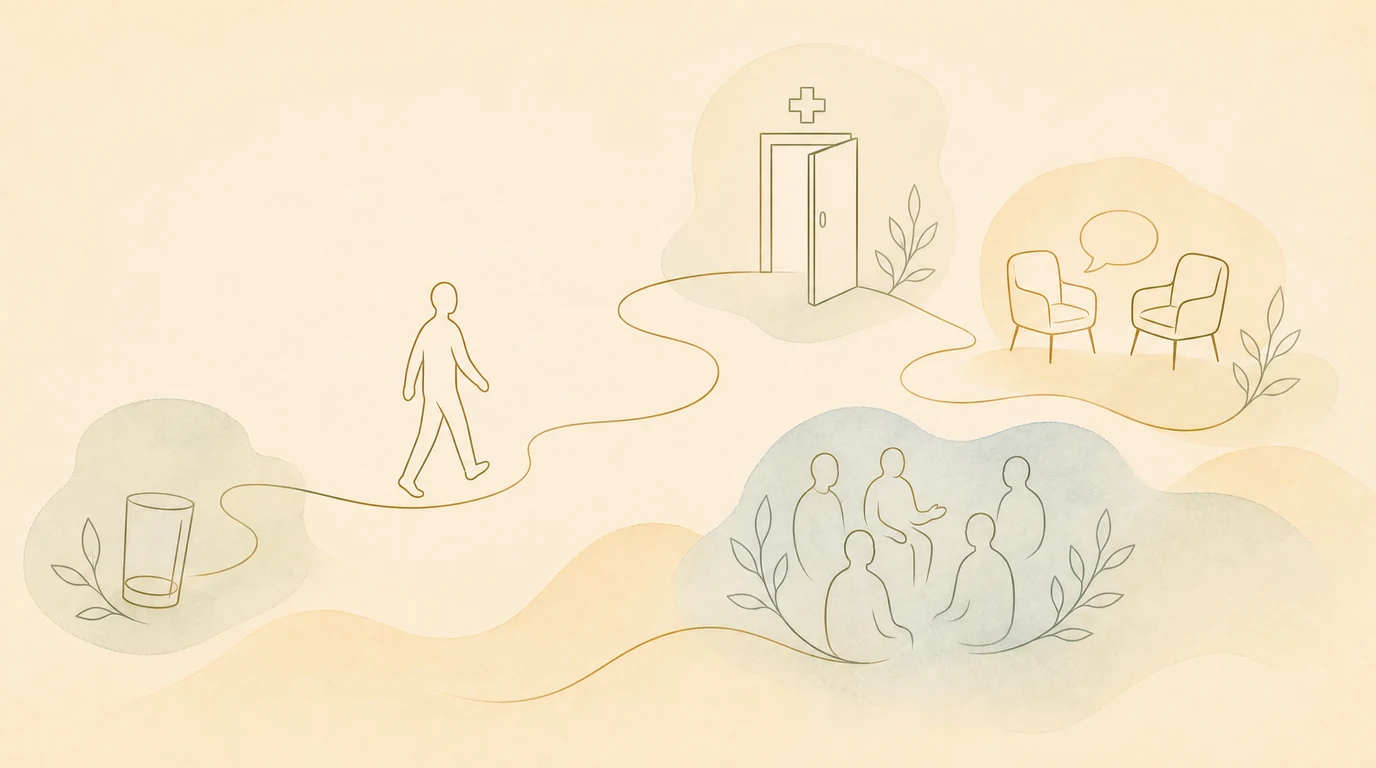
Treatment for alcohol use disorder can happen in a medical office, therapy practice, outpatient program, residential setting, peer-support meeting, or a combination of these. The word treatment covers this full range of services.
You can ask for help while pursuing abstinence, reducing alcohol-related harm, or deciding what change is realistic. A useful starting point is an assessment of your current drinking, health, safety, goals, and daily circumstances.
If you may be physically dependent on alcohol, get medical guidance before abruptly stopping. The alcohol safety guide explains warning signs and routes to urgent care without treating every drinking pattern as a medical emergency.
Key takeaways
- Alcohol treatment includes outpatient, medical, psychological, residential, and peer-led options
- Many people begin in primary care or outpatient treatment and never enter residential rehab
- Medication, therapy, and peer support can be used separately or together
- The right intensity depends on safety, health, stability, access, preferences, and previous response
- A credible service explains its methods, qualifications, costs, privacy rules, and follow-up plan
Begin with an assessment
An alcohol assessment gathers information that affects treatment decisions. It may cover:
- how often and how much you drink
- loss of control, cravings, and alcohol-related consequences
- previous withdrawal symptoms or seizures
- physical health, mental health, sleep, and current medicines
- other substance use, including opioids
- housing, work, caregiving, transport, privacy, and cost
- earlier treatment or attempts to change
- your preferred drinking goal and level of involvement in decisions
An assessment can happen with a primary-care clinician, addiction specialist, therapist, or treatment program. It should produce understandable next steps. It should also identify needs that require a different level of care, such as medically supervised withdrawal or urgent mental-health support.
A systematic review found that people with substance-use disorders often wanted an active role in decisions, while evidence that preference matching improves outcomes was mixed (Friedrichs et al., 2016). In a study of 242 patients with alcohol use disorder, 90% preferred an active or shared role (Friedrichs et al., 2018). Bring your priorities into the assessment so the provider can account for them directly.
Primary care and general outpatient treatment
Primary care can be an entry point for screening, medical evaluation, medication, referrals, and follow-up. Some family doctors manage alcohol treatment directly. Others work with addiction clinicians, therapists, pharmacists, or community services.
General outpatient treatment lets you live at home and attend scheduled appointments. The schedule may range from occasional medical follow-up to several therapy or group sessions each week. Telehealth can remove travel barriers when the service is licensed and appropriate for your location.
The global treatment gap remains large. A meta-analysis of 32 population studies estimated that about 17% of people with alcohol use disorder received any treatment (Mekonen et al., 2021). A 2023 review of service accessibility identified costs, wait times, travel, inconvenient hours, privacy concerns, complicated pathways, and limited integrated mental-health care as recurring barriers (Wolfe et al., 2023). Naming the barrier can help narrow the search to options you could actually use.
Intensive outpatient and day programs
An intensive outpatient program provides more structure while the person continues living outside the facility. Programs may include multiple weekly sessions, group and individual therapy, medical care, drug or alcohol testing, family work, and coordinated mental-health treatment.
A day or partial-hospital program usually occupies more hours per week and may offer closer clinical monitoring. Names and service levels differ across countries and providers, so ask for the actual weekly schedule and staffing.
These programs may fit when weekly appointments provide too little structure, daily responsibilities make residential care impractical, or a person is stepping down from inpatient or residential care. Suitability depends on medical stability, home safety, transport, and the ability to attend consistently.
Residential and inpatient treatment
Residential treatment provides a live-in environment with structured recovery services. Inpatient medical care provides hospital-level assessment or monitoring and may be used for withdrawal, serious medical complications, acute psychiatric needs, or another safety concern.
Research does not support residential care as automatically superior for every person with alcohol dependence. A review of randomized evidence found comparable outcomes for usual inpatient and outpatient treatment overall, while recognizing that inpatient or residential care can suit people who need supervised withdrawal, respite, or high-intensity support (Mattick and Jarvis, 1994).
Before entering a program, ask what happens during an ordinary day, who provides medical care, how emergencies are handled, how medication decisions are made, what family contact is allowed, and what follow-up begins before discharge. A protected month has limited value when the plan ends at the facility door.
Medication for alcohol use disorder
Medication can target drinking outcomes, alcohol reward, or the maintenance of abstinence. Commonly discussed options include naltrexone, acamprosate, and disulfiram. Availability and approval vary by country.
A 2023 systematic review included 118 studies and found moderate-strength evidence for oral naltrexone in reducing several drinking outcomes and for acamprosate in preventing return to drinking. The review emphasized that most trials also provided counselling and that personal goals and side-effect profiles matter when choosing an option (McPheeters et al., 2023).
Medication for ongoing alcohol use disorder is distinct from medication used to manage acute withdrawal. The medications for alcohol use disorder guide explains the main options, evidence, and questions for a prescriber.
Therapy and behavioral treatment
Therapy can help with motivation, drinking patterns, thoughts, emotional responses, relationships, coping, and the practical skills used between sessions. Common approaches include cognitive behavioral therapy, motivational interviewing, motivational enhancement therapy, behavioral couples therapy, and structured relapse-prevention work.
A 2023 network meta-analysis of 19 trials involving 7,149 adults found that multi-session, face-to-face motivational interviewing combined with cognitive behavioral therapy ranked highest for reducing AUDIT scores, although certainty was low for most comparisons (Tan et al., 2023). The result supports this combination as one useful option, and the low certainty leaves room for other approaches.
The therapy for alcohol use disorder guide explains what these approaches do and what to expect during treatment.
Peer-support and mutual-help groups
Peer-support groups provide regular contact with people working on similar changes. Alcoholics Anonymous uses a Twelve-Step framework. SMART Recovery uses a secular program based on self-management and cognitive-behavioral tools. LifeRing Secular Recovery and Women for Sobriety offer other approaches, and local communities may provide additional culturally specific groups.
A Cochrane review found that professionally delivered Twelve-Step Facilitation and AA participation often improved continuous abstinence compared with other established treatments, while results for other drinking outcomes varied (Kelly et al., 2020). Direct comparative evidence for newer groups is smaller.
Meetings can complement clinical care. They do not provide emergency medical treatment or individualized prescribing. The comparison of AA, SMART Recovery, and other support groups focuses on meeting style, philosophy, evidence, and fit.
Treatment goals can differ
Some services require abstinence. Others support reduced drinking, harm reduction, or a staged goal. Your medical circumstances may make abstinence the safer recommendation, and your initial goal can also change during care.
A systematic review of 22 studies found no clear overall advantage for abstinence-oriented treatment over controlled-drinking approaches in randomized trials. Goal-specific treatment appeared important, and the evidence had methodological limits (Henssler et al., 2021).
Ask how a provider works with your present goal, how progress is measured, and when the plan would be reconsidered. Treatment should still address safety and alcohol-related harm even when goals differ.
How to evaluate a provider or program
Ask direct questions before committing:
- Who completes the assessment, and what are their qualifications?
- Which treatment methods are used, and what evidence supports them?
- Can the service provide or coordinate medication?
- How are physical health and mental health assessed together?
- What happens if withdrawal or another urgent problem appears?
- What is the total cost, including tests, medicines, and follow-up?
- How is privacy protected?
- What happens after the initial program ends?
Be cautious with guaranteed outcomes, pressure to pay immediately, vague descriptions of treatment, and services that cannot explain staff credentials or emergency procedures.
Choose the smallest useful next step
The next step can be a primary-care appointment, an addiction-service assessment, a therapy consultation, a peer-support meeting, or a call to compare programs. The guide on talking to your doctor about drinking helps prepare the information and questions for a medical visit.
Write down the first action, who you will contact, and when. If the first option is unavailable, ask for another route and continue from there.