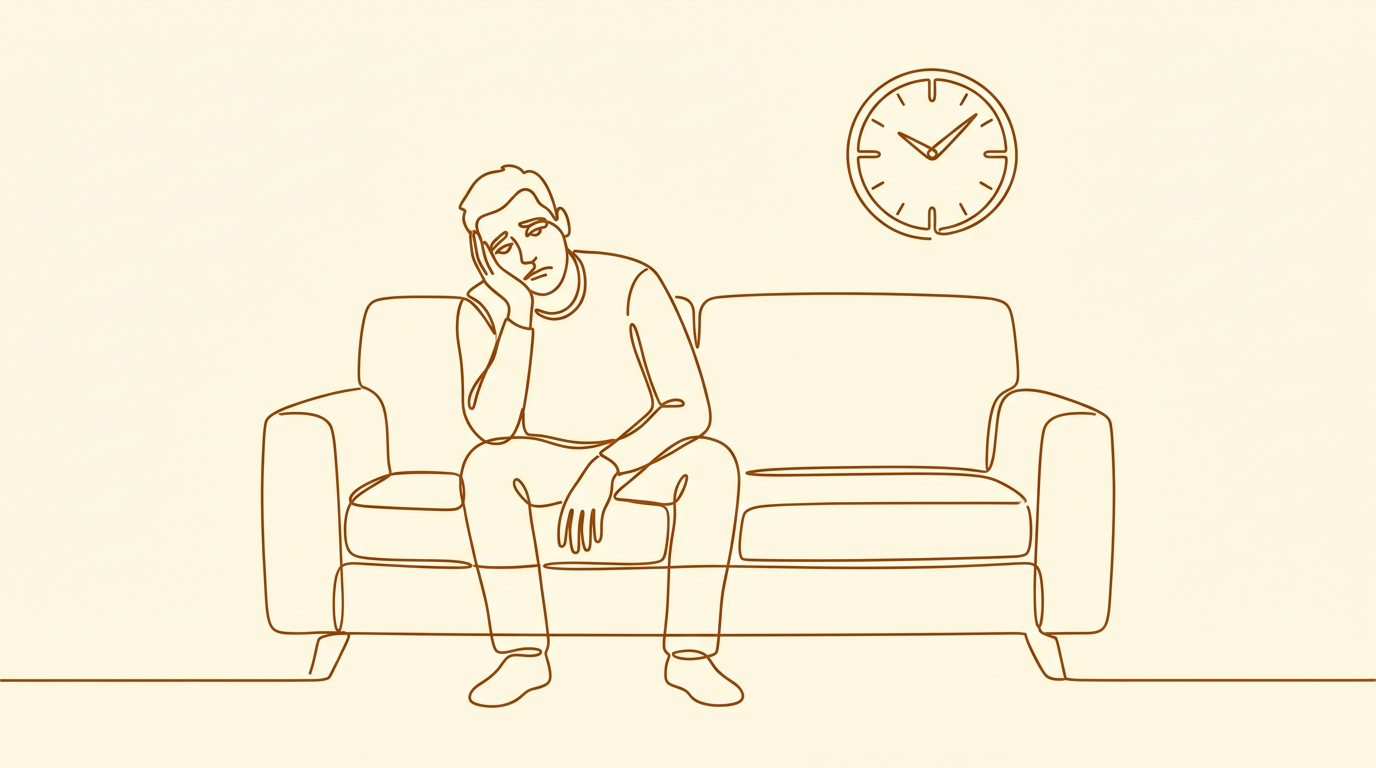
You could have all the motivation in the world. You could genuinely want to quit. And then Tuesday evening rolls around, you’re sitting on the couch with nothing to do, and within ten minutes you’re watching porn.
Boredom doesn’t look dangerous. It doesn’t feel like a crisis. But it’s the single most common trigger for porn use, and it’s responsible for more relapses than stress, loneliness, and emotional pain combined.
If you want to understand your porn triggers at a deeper level, start with our complete guide to urges and triggers. But if boredom is your weak spot, this article is where to dig in.
Key takeaways
- Boredom is the single most common porn trigger; it causes more relapses than stress, loneliness, and emotional pain combined
- There are two kinds: stimulus boredom (nothing to do) and existential boredom (nothing feels meaningful); they require different solutions
- The highest-risk window is evenings from 7 PM to midnight, when structure disappears and willpower is depleted
- Pre-decide what you’ll do during high-risk windows before the boredom hits: don’t wait until you’re already understimulated
- If activities alone don’t fix the problem, the boredom may be pointing to a deeper need for purpose, connection, or direction
Why Boredom Drives You to Porn
Your brain is a stimulation-seeking machine. It has a baseline level of arousal it wants to maintain, not too low, not too high. When stimulation drops below that baseline, your brain starts scanning for the fastest way to fix it.
Porn is neurologically efficient. It delivers a large dopamine hit with almost zero effort. No setup, no skill, no social negotiation. A few taps and your brain gets exactly what it was looking for.
Over time, this creates a direct association: boredom = porn. The connection becomes so strong that the moment you feel understimulated, the craving fires before you’ve consciously registered what’s happening.
This is why “just find something to do” is bad advice. By the time you’re bored enough to notice it, the urge is already running.
Two Kinds of Boredom (and Why It Matters)
Not all boredom is the same, and confusing the two types is one of the reasons people keep relapsing even when they have a list of alternative activities.
Stimulus Boredom
This is the surface-level kind. You have free time and nothing is grabbing your attention. The fix is straightforward: you need something engaging to do. A project, a game, a conversation, a walk, a book. Anything that gives your brain enough stimulation to stay above that baseline.
Stimulus boredom is the easier problem to solve, and most recovery advice stops here. But there’s a deeper version.
Existential Boredom
This is when you have things you could do, but none of them feel meaningful. You scroll through options (Netflix, the gym, texting someone), and everything feels flat. There’s an emptiness underneath the boredom that activities alone can’t fill.
Existential boredom often shows up when:
- You’re going through a transition (new city, post-breakup, career change)
- You lack a sense of purpose or direction
- Your daily life feels like it’s on autopilot
- You’re disconnected from the things that used to matter to you
This kind of boredom is more dangerous because no hobby list will fix it. It requires a different approach, one that addresses meaning, not just stimulation.
When Evenings Feel Empty
The highest-risk window for boredom-triggered porn use is the evening, roughly 7 PM to midnight. This is when:
- Work structure is gone
- You’re often alone
- Decision fatigue has drained your willpower
- The gap between “dinner” and “sleep” can feel enormous
If this window is where you keep relapsing, you don’t have a willpower problem. You have a structure problem. The evening needs a shape, even a loose one, so your brain isn’t left to wander toward its default.
For specific nighttime strategies, read Late-Night Urges.
How to Handle Stimulus Boredom
The goal isn’t to fill every second of your day. It’s to have a few reliable options that are engaging enough to keep your brain from drifting.
Build a Go-To List
Write down 5 to 10 activities that require mild effort and give you some engagement. Not things you “should” do, things that actually hold your attention. Examples:
- Call a specific friend (name them in advance)
- Walk a specific route in your neighborhood
- Work on a hands-on project (cooking, building, drawing)
- Play a game that requires focus (not passive scrolling)
- Go to a specific place (coffee shop, gym, library)
The key word is specific. “Exercise” is vague and easy to dismiss. “Do 20 minutes on the rowing machine while listening to a podcast” is concrete and actionable.
Pre-Decide for High-Risk Windows
Don’t wait until you’re bored to decide what to do. That’s like waiting until you’re starving to decide what to eat; you’ll grab the easiest option every time.
Before the evening starts, decide: “Tonight after dinner, I’m going to [specific activity] for at least 30 minutes.” That’s it. One decision, made in advance, when your willpower is still intact.
Use the Two-Minute Rule
When boredom hits and you feel the pull, commit to just two minutes of an alternative activity. Not thirty minutes. Not an hour. Two minutes. Start the walk. Open the sketchbook. Pick up the guitar.
The hardest part is starting. Once you’re two minutes in, momentum usually carries you forward. And those two minutes are often enough to break the urge cycle. For more on physical interrupts, see Physical Resets That Interrupt Urges.
How to Handle Existential Boredom
This is the harder one, and there’s no quick fix. But there are starting points.
Notice the Emptiness Without Fixing It
When everything feels flat and meaningless, the instinct is to numb it immediately. Porn is one way. Scrolling is another. Alcohol is another. But all of these just delay the feeling; they don’t resolve it.
Try sitting with the emptiness for five minutes. Not to punish yourself. Just to observe. What does it actually feel like? Where do you feel it in your body? What thought keeps cycling through your head?
This is uncomfortable, but it’s also information. The emptiness is telling you something about what’s missing.
Ask the Harder Questions
If you’re consistently bored in a way that activities can’t fix, something bigger is probably off:
- Do you have relationships where you feel genuinely known?
- Is there anything in your life you’re building toward?
- When was the last time something felt meaningful (not just fun, but meaningful)?
- Are you avoiding a decision or change that you know you need to make?
You don’t have to answer these all at once. But start asking them. Recovery from porn often leads people into these questions eventually, because the porn was filling a gap that doesn’t go away just because you stopped watching.
Build One Thing That Matters
You don’t need a grand purpose. You need one thread of meaning. One project, one relationship, one practice that gives your days a sense of direction.
This could be as simple as committing to a weekly dinner with a friend, starting a creative project with no deadline, volunteering somewhere, or learning a skill that genuinely interests you.
The point isn’t productivity. It’s engagement, giving your brain something real to connect with so it stops reaching for the artificial version.
Boredom Will Come Back
You can’t prevent boredom. It’s a normal human experience, and it’ll show up regularly for the rest of your life. The goal isn’t to eliminate it; it’s to change your default response.
Right now, your default is: boredom → porn. You’re building a new default: boredom → [something that actually helps].
That takes repetition. It takes having a plan. And it takes being honest about which kind of boredom you’re dealing with, because the solution for “I have nothing to do tonight” is very different from the solution for “nothing in my life feels like it matters.”
Both are workable. But only if you’re willing to name what’s actually going on.
If you’re ready to build a broader understanding of your trigger patterns, go back to Urges and Triggers: The Complete Guide. If boredom tends to hit hardest at night, read Late-Night Urges next.