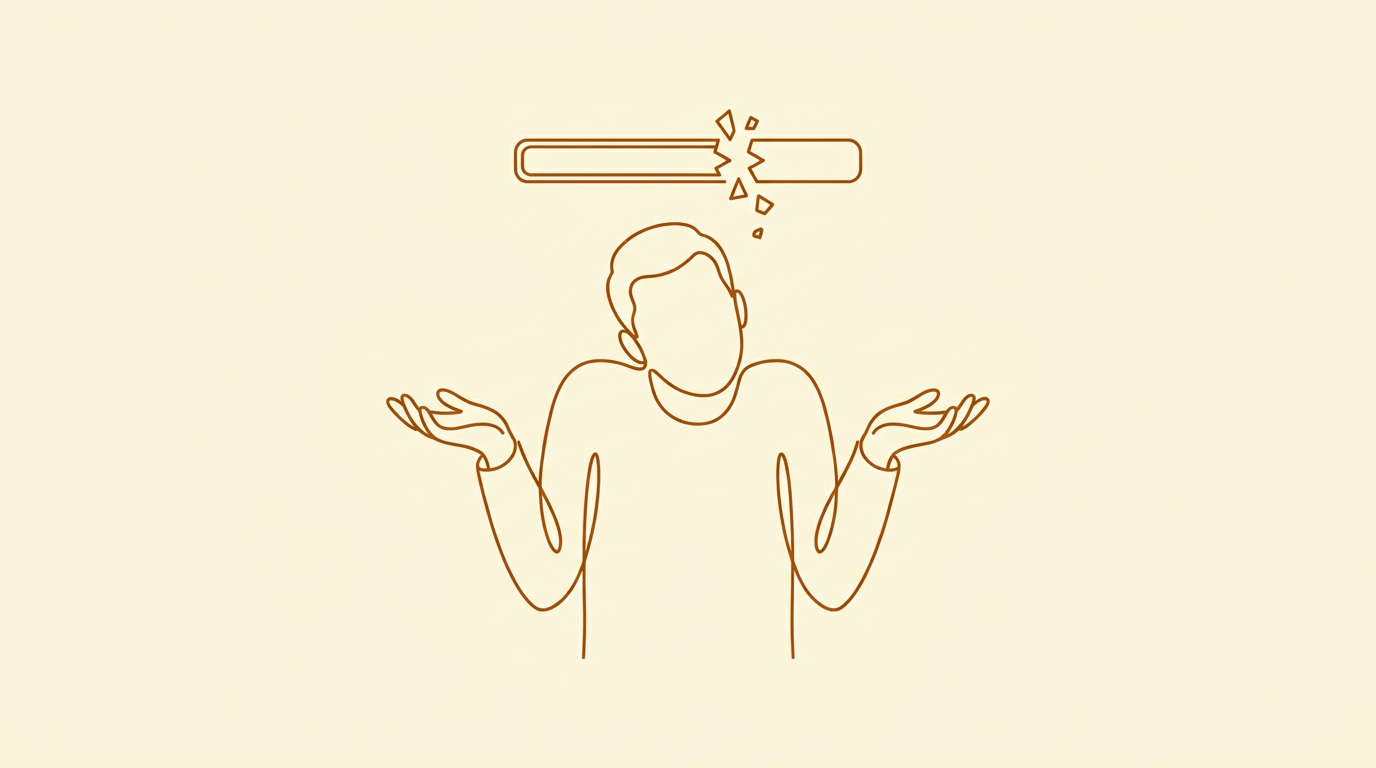
You were doing well. Days, maybe weeks, without porn. Then you slipped. And within hours (sometimes minutes), you were right back to where you started. Not because the urge was that strong, but because a voice in your head said: “Well, I already ruined it. Might as well go all in.”
That voice has a name. Psychologists call it the abstinence violation effect. In everyday language, it is the what-the-hell effect. And it is one of the most destructive patterns in porn recovery, not because of the initial slip, but because of what it convinces you to do next.
Key takeaways
- The what-the-hell effect (abstinence violation effect) is what turns a single slip into a full binge, it’s more damaging than the relapse itself
- The pattern runs on all-or-nothing thinking: one violation triggers disproportionate shame, which demands relief, which leads to more use
- Redefine success as a ratio, not a streak: 30 clean days out of 31 is a 96.8% success rate, not a failure
- Pre-decide your post-slip response before a relapse happens so you don’t have to make decisions while emotionally flooded
- Separate the slip from the spiral; they are two different events, and you choose whether to connect them
How the Pattern Works
The what-the-hell effect follows a predictable sequence:
- You set an all-or-nothing goal. “I will never watch porn again.” “I will reach 90 days no matter what.”
- You violate the goal. A single slip. Maybe a few minutes. Maybe less.
- The violation triggers a disproportionate emotional response. Shame, guilt, hopelessness. Not proportional to the slip, but proportional to the meaning you attached to the streak.
- The emotional pain demands relief. Your brain is now flooded with distress. And it knows one very fast way to numb distress.
- You binge. Not because you wanted to, but because “I already failed, so what’s the difference?”
The cruel logic is this: the more important the goal was to you, the more devastating the violation feels, and the more likely you are to abandon the goal entirely after a single failure.
The Research Behind It
The abstinence violation effect was first identified by addiction researchers Alan Marlatt and Judith Gordon in the 1980s. They noticed that people in recovery from alcohol and substance use often did not relapse gradually. They relapsed catastrophically, and the catalyst was not the substance itself but their psychological response to the first lapse.
The same pattern shows up across behavioral change: dieters who eat one cookie and then finish the box, exercisers who miss one day and then skip the whole week, people quitting porn who slip once and then binge for three days straight.
The mechanism is consistent: a rigid goal creates a binary identity (I’m succeeding / I’m failing), and any violation flips the switch entirely.
Why It Hits So Hard in Porn Recovery
Porn recovery is especially vulnerable to the what-the-hell effect for several reasons:
The behavior is private. Unlike other habits, there is rarely anyone watching in real time. The binge happens in isolation, which means there is no external friction to interrupt it.
Shame is already high. Most people trying to quit porn carry significant shame about the behavior. A relapse does not just feel like a setback; it feels like confirmation of a feared identity. “I really am that person.”
The neurochemical crash demands relief. After a relapse, dopamine drops and stress hormones spike. Your brain is in a state of acute discomfort. The fastest path back to comfort is the same behavior that caused the crash. It is a vicious loop.
Streak culture reinforces all-or-nothing thinking. If your entire recovery identity is tied to a number (“I’m on day 47”), then a reset to day zero feels like total erasure. That feeling of erasure is the fuel for the what-the-hell effect. (More on this in why streaks help some people and hurt others.)
How to Interrupt the Pattern
The what-the-hell effect is powerful, but it is not inevitable. Here is how to break the chain before a slip becomes a spiral.
1. Redefine Success as a Ratio, Not a Streak
If you were porn-free for 30 days and slipped on day 31, you succeeded 96.8% of the time. That is not failure. That is a dramatic change from where you started.
Recovery is not binary. You are not “clean” or “ruined.” You are somewhere on a spectrum, and one slip moves the needle far less than the what-the-hell effect wants you to believe.
2. Pre-Decide Your Post-Slip Response
The best time to plan for a relapse is before it happens. Write down (literally, on paper or in a note) exactly what you will do if you slip:
- “I will close everything, leave the room, and splash cold water on my face.”
- “I will not look at my streak counter for 24 hours.”
- “I will write three sentences in my journal about what happened.”
- “I will text my accountability partner.”
When the what-the-hell voice shows up, you do not need to make a decision. You just follow the plan.
3. Separate the Slip From the Spiral
Say this to yourself, out loud if needed: “The slip already happened. The binge has not. Those are two different events and I am choosing not to connect them.”
This sounds simple. It is. The difficulty is not intellectual; it is emotional. The shame wants to blur the line between a stumble and a fall. Your job is to keep that line sharp.
4. Get Out of the Environment
If you are still in the same room, on the same device, in the same physical position where the slip happened, leave. Physically relocate. The environmental cues will keep pulling you back into the loop. Remove yourself from them.
5. Use a Time-Based Commitment
Tell yourself: “I am going to do something else for the next thirty minutes. After that, I can reassess.” This is not about permanent willpower. It is about borrowing enough time for the craving to drop. Cravings peak and fall. If you can ride the first 15-20 minutes without feeding the urge, the intensity drops significantly.
6. Disarm the Shame
The what-the-hell effect is powered by shame. The voice says: “You’re weak. You failed. Nothing works. You’ll never change.”
Answer it directly: “I slipped. I am human. One slip does not erase weeks of progress. I am getting back on track now.”
This is not positive thinking. It is accurate thinking. The catastrophic version is the distortion.
For more on moving through guilt without making excuses, read about forgiving yourself after a relapse.
A Slip Is Not a Sentence
The what-the-hell effect thrives on a specific lie: that there is no meaningful difference between a slip and a binge. That once the streak is broken, the damage is done, so you might as well keep going.
That is like saying there is no difference between tripping on a staircase and throwing yourself down the stairs. The fall is not the same. The recovery is not the same. The choice is not the same.
You slipped. That is real. Now you have a choice, and it is the most important choice in your entire recovery. Not the choice you made twenty minutes ago, but the one you make right now.
Stop. Get up. Close the loop. Move on.
The what-the-hell effect only wins if you let one moment define the whole day. Don’t give it that power.